How do archaeologists date things?
Archaeologists date things in two steps: first they put finds in order using layers and context (relative dating), then they attach years using methods such as radiocarbon or tree rings (absolute dating). A good date uses both, and says how sure it is.
The slider above is a real example. Researchers led by Margot Kuitems found the AD 993 cosmic-ray spike in wood cut by the Norse at L'Anse aux Meadows, counted the rings after it, and got one year: 1021 (Archaeology magazine, 2021; Kuitems and colleagues, Nature, 2021). That is how a vague "around 1000" becomes a single year.
A date that is still argued about
For a long time, the day Vesuvius buried Pompeii came from copies of a letter by Pliny the Younger, which give August 24, AD 79. Then, in 2018, excavators found a charcoal note on a wall with a mid-October date, reported by ANSA in 2018. Because charcoal fades and smudges easily, researchers argued it was written shortly before the eruption, which would point to autumn, not summer.
Nobody can fully settle it, because both clues are about writing, not chemistry. A copied letter can carry a copying error; a note on a wall has no year on it. This is why historians say "the evidence suggests" so often. PastRush turns this into its second case, "The Disputed Day", where you weigh the sources yourself.
Archaeology dating terms, A to Z of the dig
The words run in the order you would meet them: first ordering things, then putting years on them, then writing those years down.
Putting things in order
Relative dating
Saying which thing is older or younger without giving a year. It is the first question on almost every dig.
Stratigraphy
Reading layers of soil or rock like pages in a stack. Each layer is a moment when something was laid down.
Law of superposition
In undisturbed layers, the lower ones are older. The National Park Service uses it for the Grand Canyon: oldest rocks at the bottom, around 1.8 billion years old, and the Kaibab Formation at the top, about 270 million.
Context
Exactly where an object was found and what was next to it. A coin in a museum drawer tells you less than the same coin found sealed under a floor.
Typology
Dating objects by style. Pots, tools and brooches change shape over time, so a known style points to a known period.
Terminus post quem
Latin for "the limit after which". A coin minted in 1650 in a layer means the layer cannot be older than 1650.
Terminus ante quem
"The limit before which." If a floor built in 1700 seals the layer, the layer must be older than 1700.
Putting years on things
Absolute dating
Any method that gives a year or a range of years, not just an order.
Radiocarbon dating
Living things take in carbon, including a little radioactive carbon-14. After death it slowly decays, so measuring what's left in wood, bone or seeds says how long ago the thing died.
Calibration
Radiocarbon years are not calendar years. Scientists correct them using long records such as tree rings, which is why a radiocarbon date comes as a range.
Dendrochronology
Tree-ring dating. Each ring is one year of growth, and wide and narrow rings make patterns that can be matched across trees.
Cosmic-ray marker
A sudden burst of radiation from space left a spike of carbon-14 in tree rings in AD 993. Find that ring, count outward to the bark, and you get the year a tree was cut.
Writing dates down
BP
"Before Present", a scientific way of writing ages. By convention, the present means AD 1950, so 5,000 BP is about 3050 BC.
Circa (c.)
Latin for "around". "c. AD 1000" means about the year 1000, and tells you the date is an estimate.
The one-line version: layers give the order, science gives the years, and good labels say how sure we are.
How PastRush turns this into a game, in 3 steps
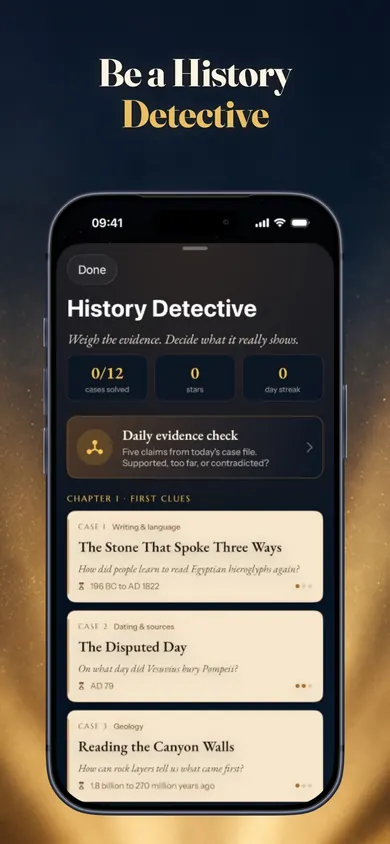
- Open a case file. Each exhibit is labelled: made at the time, written later, scientific finding or modern reconstruction.
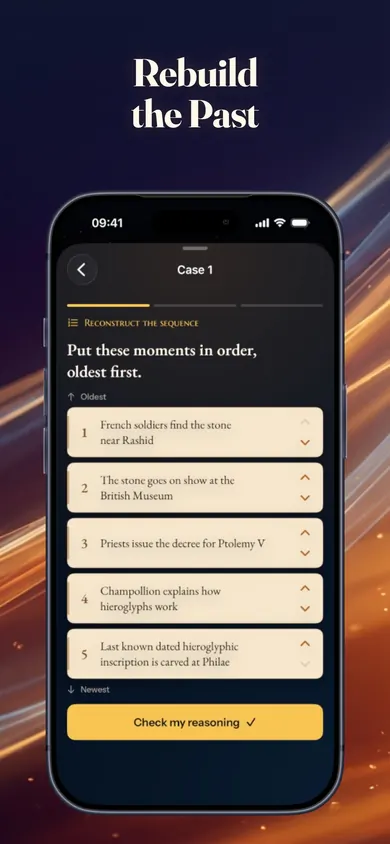
- Rebuild the order. Chronology puzzles ask you to put events in sequence, with BC and AD handled correctly, and a true-scale time bar shows the real gaps.
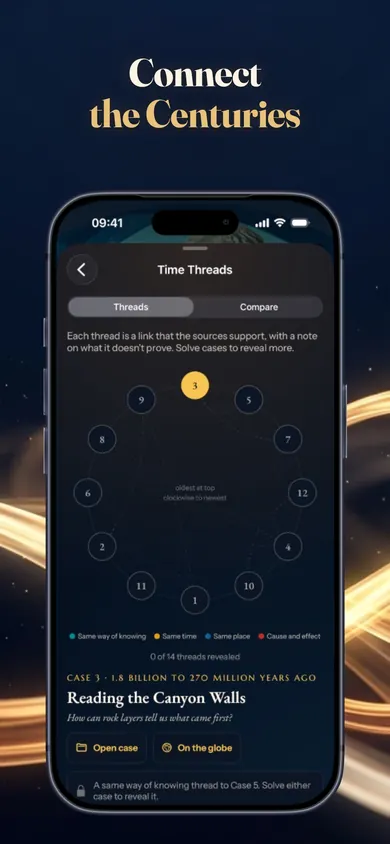
- Decide what the evidence proves. Sort claims into supported and going too far. Every answer explains why and links to its source.
Honest limits
- PastRush is a history game, not a lab. It teaches how dates are argued from evidence; it doesn't simulate radiocarbon measurement.
- Six cases are free: the Rosetta Stone, Pompeii, the Grand Canyon's rock layers, Ötzi the Iceman, continental drift and the Norse in Vinland. Cases 7 to 12 need a one-time purchase, listed on the App Store as PastRush Pro Lifetime at $99.99 (the description calls it Founder Lifetime). No subscription.
- Rated 9+ on the App Store, English only, iOS 18 or later. The satellite views and map games need internet; cases and the Notebook work offline.
- Who should pick something else: kids who want hands-on digging will get more from a museum or a dig day; a younger child who isn't reading yet will find the case files too wordy.
Relative vs absolute dating
| Relative dating | Absolute dating | |
|---|---|---|
| Answers | Which came first? | How many years ago? |
| Tools | Layers, context, style | Radiocarbon, tree rings, dated writing |
| Example | Grand Canyon layers, oldest at the bottom | Norse woodcutting in AD 1021 |
| PastRush case | Reading the Canyon Walls | The Norse in Vinland |
Writing can be dated too: the Rosetta Stone's decree was carved in 196 BC, for the first anniversary of Ptolemy V's coronation, says the British Museum. And sometimes a museum gives only an age: Ötzi lived more than 5,300 years ago, according to the South Tyrol Museum of Archaeology.
Try it: date this layer
A layer holds a coin minted in 1650. A stone floor laid in 1700 sits on top and was never disturbed. When did the layer form?
Pick one.
The design decision we made: PastRush leaves out dates that historians still debate in its Which Came First? game, so every round has one right answer. The debates get their own cases instead.
Questions kids and parents ask
How do archaeologists know how old something is?
They combine methods: layers and context put finds in order, then methods such as radiocarbon or tree rings put years on that order. One method alone is rarely trusted.
What is the most accurate dating method?
For the last few thousand years, tree rings can give a single calendar year, as at L'Anse aux Meadows, where Norse woodcutting was dated to AD 1021. Radiocarbon usually gives a range.
Can radiocarbon date rocks or dinosaurs?
No. Radiocarbon dates once-living material such as wood, bone and seeds. Rock layers like the Grand Canyon's are dated with other methods and with their order in the stack.
What does BP mean in archaeology?
Before Present. The present is fixed at AD 1950, so dates in BP do not change every year.
What is the difference between relative and absolute dating?
Relative dating gives an order (this layer is older than that one). Absolute dating gives a number of years. Most dates in a museum label come from both working together.
Is there a game that teaches dating evidence?
We make PastRush: History Detective. Its free Grand Canyon case uses rock layers, its Pompeii case is about a disputed date, and its Chronology puzzles handle BC and AD correctly.
Solve a dating case tonight
Start with the Grand Canyon's layers or Pompeii's disputed day. Both are free.

Open PastRush in the App Store
Updated November 2026
Related
- How to make history fun for kids: a 3-tap hook finderKid says history is boring? Three taps match your child to a hook (puzzles, maps, collecting or arguing) with a 15-minute activity to try tonight.
- PastRush: the history detective game with real evidencePastRush is a history detective game: order events, weigh sources and decide what evidence proves. Six cases free on iPhone, no ads, no account.
- How to fact-check history videos in 5 questionsHeard a history 'fact' in a video? Five questions catch most myths before you repeat them. Four real myths flipped, with museum and journal sources.
- History activities before winter break: a 5-day planA 5-day history detective plan for the last week before winter break: 15-20 minutes a day, real evidence, a chronology warm-up you can run today.