How do you fact-check a history video?
Ask five questions: what kind of evidence is this, who said it first, does the source support the claim or go further, is it debated, and does an independent expert source agree? Most viral history myths fail at question one or two, long before you need a library.
All four cards above passed through plenty of videos. Each one fails a different question, which is why we built the steps below around them.
Honest limits
- Five questions won't make you a historian. They help you sort "well supported" from "needs checking"; they can't settle a real scholarly debate.
- PastRush is a game. It practices these questions on 12 prepared cases, not on the videos in your feed.
- Six cases are free. Cases 7 to 12 come with a one-time purchase, listed on the App Store as PastRush Pro Lifetime at $99.99 (the description calls it Founder Lifetime). No subscription, no ads.
The 5 questions, in one group chat
Did you know the Rosetta Stone is in three languages? Saw it in a video.
Hang on. Let me run the five questions.
Question 1
What kind of evidence is it?
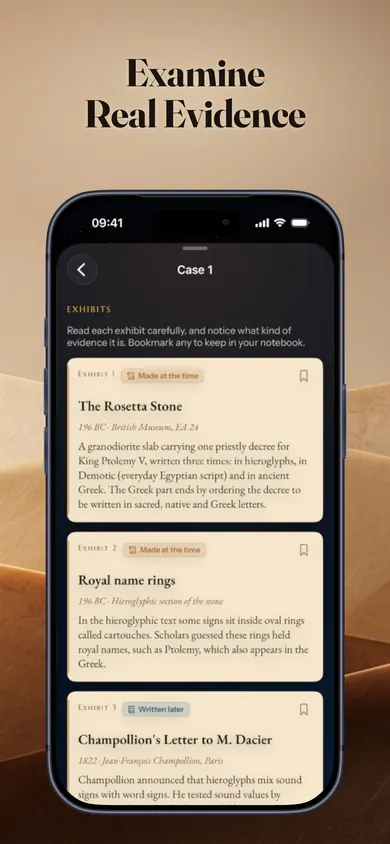
Something made at the time, something written later, a scientific finding, or a modern reconstruction? A video is none of these. It's a retelling, so look for what it is retelling.
It's from a big channel though.
Question 2
Who said it first?
Follow the claim back. A video quoting another video isn't a source. A museum, an excavation report or a journal article is. If you can't find where it started, hold it.
The British Museum says three scripts. Hieroglyphs and Demotic are both Egyptian. So two languages.
Question 3
Does the source support it, or go further?
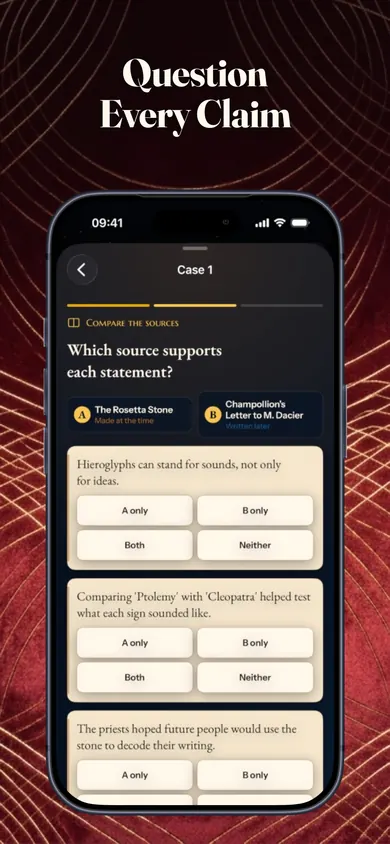
Sources often say less than the video. "Three scripts" became "three languages" somewhere along the way. Ask what the source shows, and what neither source shows.
OK but the Pompeii date is definitely August 24.
Question 4
Is it debated?
Dates, death tolls and causes are often argued over. Pompeii's date is one: a 2018 charcoal note points to October. A careful video says "probably"; a careless one picks a side and never mentions the other.
Question 5
Does an independent expert agree?
Check one source with no stake in the video: a museum, a national park service or a peer-reviewed journal. If they agree, share it. If they disagree, you've found a myth.
Fine. Two languages. Sending you the next one I see.
The short version: a video is a retelling, so find what it retells.
Who this is not for
If you need to check a claim for school or work, go straight to the sources and skip the game. If you want history as storytelling, with no homework, a good podcast will suit you better than PastRush, which asks you to judge every exhibit. And if reading on a phone tires you, the case files are text-heavy by design.
Fact-checking history: common questions
How do you know if a history video is accurate?
Check whether it names its sources, whether those sources are from the time or written later, and whether an independent expert source, such as a museum, a national park service or a peer-reviewed journal, says the same thing.
What are the most common history myths online?
Tidy single dates for events that are debated, 'firsts' that ignore earlier evidence, and dramatic causes of death or downfall that the evidence doesn't support. The four cards at the top of this page are examples of each.
Are history YouTubers reliable?
Some are careful and cite their sources on screen or in the description; some repeat each other. Judge the video, not the channel: a good one tells you where each claim comes from.
What is a primary source in history?
Something made at the time: a letter, an inscription, an object. A secondary source is written later about it. Both are useful; they answer different questions.
What should I do if a claim is debated?
Say so when you repeat it. "Probably October, though older sources say August" is more accurate, and more interesting, than a single confident date.
Is PastRush for adults?
Yes. It's rated 9+ and has a Class mode for families and classrooms, but the case files are real investigations with labelled exhibits and sources, and the Daily Evidence Check gives anyone five claims to judge each day.
A ten-minute evening with PastRush
Open the free Rosetta Stone case after dinner. The exhibits come labelled: the stone itself is marked made at the time; Champollion's 1822 letter is marked written later. You rebuild the order of events, from the decree in 196 BC to the stone going on show at the British Museum. Then the comparison round asks which source supports each statement. The answers explain why and link to the source. Ten minutes in, you have practiced questions one to three without noticing.
The design decision we made: story pictures in PastRush are AI-assisted illustrations, and they are marked as illustrations, never shown as photos of real objects. A history game that teaches source-checking had better label its own sources.
Run the check on a claim you heard
Think of one history claim from a video. Tick each question it passes.
0 of 5: hold it for now.
Practice on real case files
Six free investigations, every exhibit labelled. Try it tonight.

Open PastRush in the App Store
Updated November 2026
Related
- How to get into history as an adultNever liked history at school? Start with one question and real evidence. A 3-tap quiz picks your first case and builds 7 short evenings.
- PastRush: the history detective game with real evidencePastRush is a history detective game: order events, weigh sources and decide what evidence proves. Six cases free on iPhone, no ads, no account.
- History activities before winter break: a 5-day planA 5-day history detective plan for the last week before winter break: 15-20 minutes a day, real evidence, a chronology warm-up you can run today.
- History apps for homeschool middle school: questions answeredWhich history apps actually teach middle schoolers to weigh evidence? Answers for homeschool parents, a weekly-minutes planner and an honest comparison.