I never liked history at school. Is it too late to get into it?
How do you get into history as an adult?
Pick one question you genuinely want answered, look at the real evidence for it, and ask what that evidence can and cannot prove. That is what historians do, and it is far more fun than the date lists most of us remember. Twenty minutes a few evenings a week is plenty.
Three good first questions, if none comes to mind:
- How did anyone learn to read Egyptian hieroglyphs again, after centuries when nobody could?
- How do we know Norse people were in Newfoundland? Tree rings: a 2021 study in Nature, summarised on Wikipedia's L'Anse aux Meadows page, dated wood cut there to AD 1021.
- What can a man found in Alpine ice tell us? Ötzi lived over 5,300 years ago and was found by hikers in 1991, says the South Tyrol Museum of Archaeology.
Start with a question, not a timeline.
OK. So what does my first week actually look like?
Your first week, from the quiz
Here is the default week. Take the quiz at the top and it rebuilds around your answers.
Seven short evenings beat one long weekend you never get round to.
And how does each evening work?
How a history case works, in 3 steps
- Read the exhibits. Each one is labelled: made at the time, written later, scientific finding or modern reconstruction.
- Do the reasoning. Put events in order, compare two sources, link causes to effects, or sort claims into supported and going too far.
- See why. Every answer explains itself and links to the source behind it. Save anything that surprised you to your Notebook.
Read, reason, then check the source. That is the whole method.
Does this really stick for someone like me?
A likely first week
Evening one, you open the Rosetta Stone case expecting a quiz and get a puzzle instead: three scripts, one decree, and a letter written 2,000 years later by the man who cracked it. You get the order wrong once. The explanation tells you why, and it is oddly satisfying.
By evening four you are reading about the Grand Canyon and realise the walls are a timeline: the National Park Service puts the oldest rocks at the bottom at 1.8 billion years and the Kaibab layer at the rim at 270 million. On evening six you catch yourself asking a friend, "but how do we know that?"
The moment you ask "how do we know?", you are into history.
What does the app look like?
Proof: three screens from the store
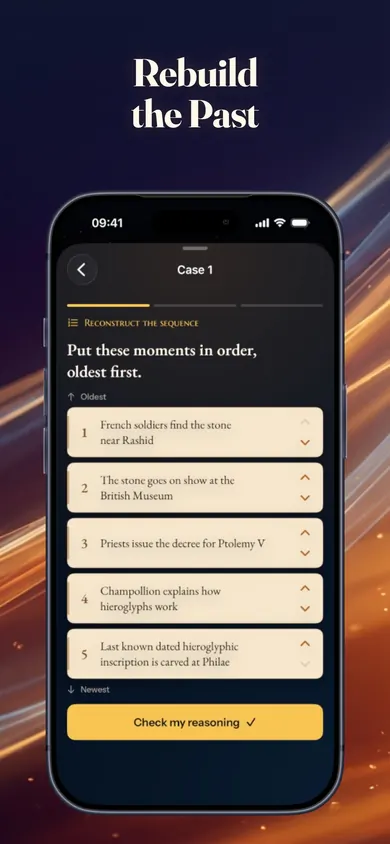
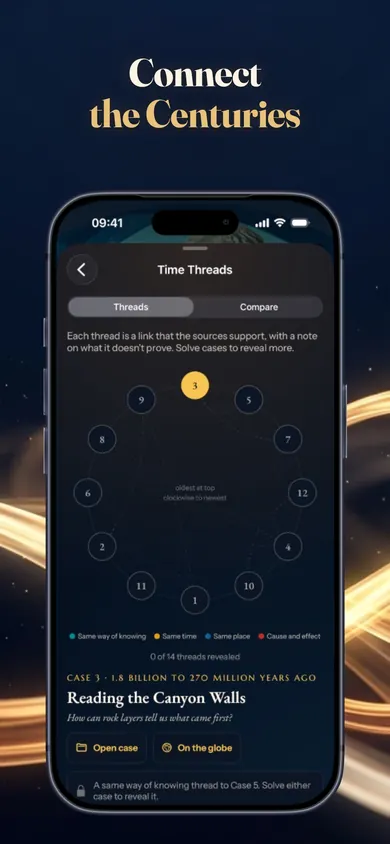
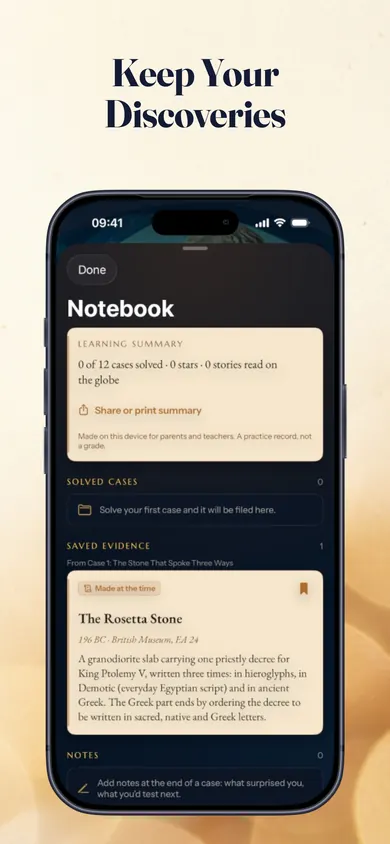
A few quick questions first.
Beginner history questions
How do I start learning history as an adult?
Start with one question you actually care about, not a full timeline. Look at the evidence for it, ask what it can and cannot prove, and let the next question lead you on. Ten or twenty minutes a few evenings a week is enough.
Why did I find history boring at school?
For many people school history meant memorising dates and names for a test. The interesting part, working out how anyone knows what happened, often got squeezed out. Starting from evidence brings it back.
What is a primary source?
Something made during the time you are studying. The Library of Congress calls primary sources the raw materials of history. PastRush labels every exhibit as made at the time, written later, a scientific finding or a modern reconstruction.
Is PastRush only for kids?
No. It suits curious adults who want short sessions of real reasoning: putting events in order, weighing one source against another, and deciding what evidence can and cannot prove. It also has a Class mode for families and teachers.
How much of PastRush is free?
Six of the twelve investigations are free: the Rosetta Stone, Pompeii, the Grand Canyon rock layers, Ötzi the Iceman, continental drift and the Norse in Vinland. Founder Lifetime, a one-time purchase, adds the other six, every globe story collection and the Master tier.
Does PastRush have ads or need an account?
No ads, no account and no tracking, according to its App Store listing. Cases and your Notebook work offline.
Be honest. Who should skip it?
Who PastRush is not for
- If you want a narrated story to listen to on a commute, a history podcast or audiobook will suit you better. PastRush asks you to tap, sort and decide.
- If you want modern political history, the twelve cases are about ancient and deep time: writing, volcanoes, rock, ice, plates and voyages.
- If you want everything without paying, six cases are free and six need Founder Lifetime.
One design decision we made: debated dates are left out of Which Came First?, so every round has one right answer. The limit is that some of history's best arguments are not in that mode; they live in the cases instead.
Open your first case tonight
Download free on the App Store. Six cases, no ads, no account.

PastRush: History Detective on the App Store · Updated November 2026
Related
- PastRush: the history detective game with real evidencePastRush is a history detective game: order events, weigh sources and decide what evidence proves. Six cases free on iPhone, no ads, no account.
- History activities before winter break: a 5-day planA 5-day history detective plan for the last week before winter break: 15-20 minutes a day, real evidence, a chronology warm-up you can run today.
- History apps for homeschool middle school: questions answeredWhich history apps actually teach middle schoolers to weigh evidence? Answers for homeschool parents, a weekly-minutes planner and an honest comparison.
- How to count years from BC to AD: the no-year-zero ruleAdd the two years, then subtract one, because 1 BC is followed by AD 1. A free BC to AD calculator and a 4-step visual guide with real dates.