Krono
Drag history cards into chronological order; a Pinpoint mode guesses years.
- Sources
- Every question links to Wikipedia
- Price
- Free with subscription ($2.99/mo, $19.99/yr) or $49.99 one-time
- Age
- 13+
PastRush · for homeschool families
History apps that make middle schoolers weigh evidence, not just memorize dates. Plan a week below.
 Free on iPhone · 6 cases free
The best history apps for a homeschooled middle schooler are the ones that ask your child to reason from evidence, such as ordering events, comparing sources and judging claims, rather than only recalling dates. Trivia and timeline apps are good for recall; reasoning apps build the skill middle school history standards actually ask for. We make PastRush, a reasoning app, and we compare it fairly with three others below.
Recall is a fact. Reasoning is a habit. Middle school is when the habit starts.
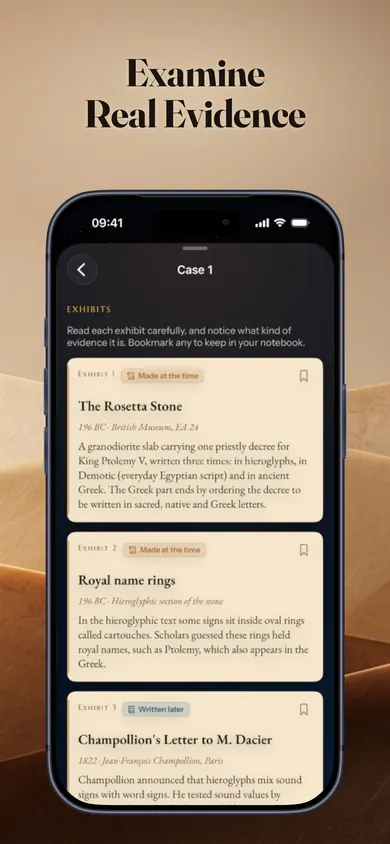
Twenty minutes before lunch. Your twelve-year-old opens Case 6, the Norse in Vinland, and meets two kinds of evidence: medieval sagas written down long after the voyages, and the excavated site at L'Anse aux Meadows in Newfoundland. The question on screen is not “when did the Vikings arrive?” but what each source can and cannot show.
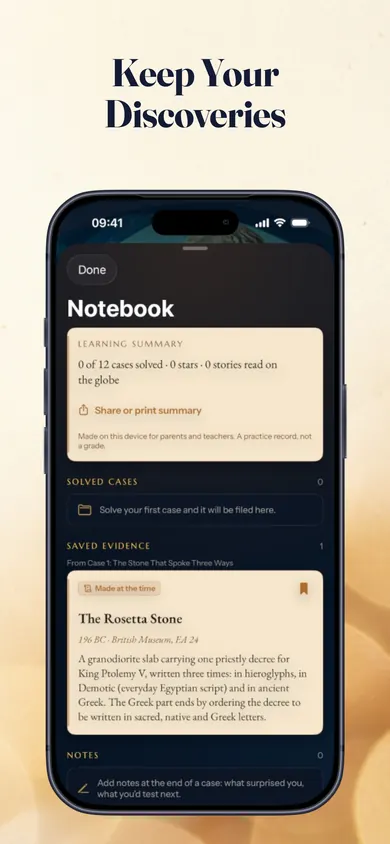
They put a saga in “written later”, argue with you about whether that makes it useless, and save an exhibit to the Notebook. You did not lecture once.
In 2021 researchers used tree rings in wood cut at L'Anse aux Meadows, matched to a solar storm of 993, to date Norse woodcutting there to the year 1021 (National Geographic, October 2021, reporting a study in Nature). It is a good talking point for “scientific finding” versus “written later”.
On its own, rarely. Most history apps are practice or enrichment: they sharpen dates, places and reasoning but do not cover a full year's scope. Pair one with a spine (a textbook, a living-books list or a curriculum) and let the app carry the hands-on reasoning.
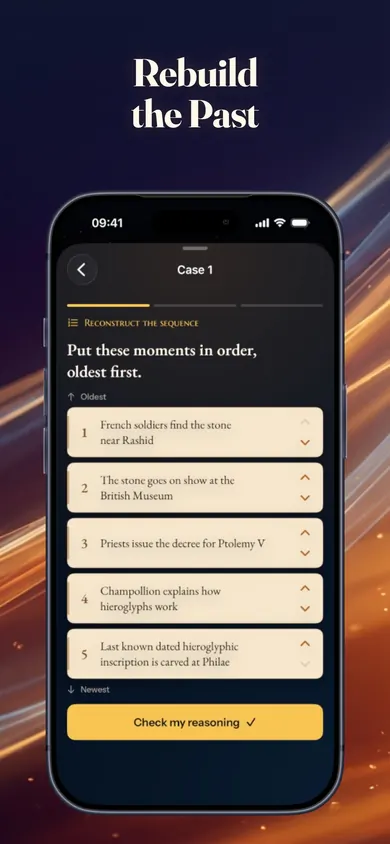
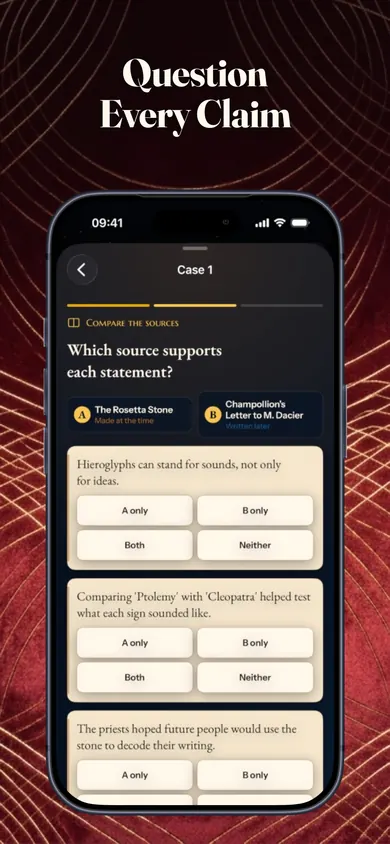
A trivia app asks you to recall a fact or a date. A reasoning app hands you sources and asks what they support. PastRush is built on the second idea: put events in order, compare two sources, and sort claims into supported and going too far.
Six of its 12 investigations are free for everyone: the Rosetta Stone, Pompeii, the Grand Canyon rock layers, Ötzi the Iceman, continental drift and the Norse in Vinland. The other six, every story collection on the globe and the Master tier come with Founder Lifetime, a one-time purchase with no subscription.
The listing says no account, no ads and no tracking. Class mode hides purchases and outside links on shared devices. Some features, such as the satellite map and Where in the World?, need an internet connection.
Yes. The listing says Founder Lifetime works with Apple Family Sharing, while progress and notes stay on each device.
It depends on the reader. We would budget 20 to 30 minutes for a first case, including reading the labelled exhibits carefully. The Daily Evidence Check, five claims a day, is much shorter.
Yes. The offline Notebook keeps saved exhibits and notes, and the Notebook screen in the App Store screenshots shows a learning summary with a share or print option.
No. It is an iPhone app from the App Store.
Checked against each App Store listing or website on 3 November 2026. We make PastRush.
Drag history cards into chronological order; a Pinpoint mode guesses years.
Drop event cards on a timeline; three misses end the game.
Website from the National Archives Foundation with 13,000+ primary source documents and activities.
12 case files: order events, compare sources, trace causes, judge claims.
Fair to say: DocsTeach has vastly more primary sources than any app, and it is free. If you are happy to sit at a laptop and lead the lesson, start there. PastRush is for the phone in your child's hand, with the reasoning built into the game.
One case a week, one conversation on Friday. That is a semester of reasoning practice.
Six investigations are free. No account, no ads, no tracking.
Start on your iPhone: PastRush on the App Store · Updated November 2026