Library of Congress
A Primary Source Analysis Tool built on observe, reflect and question, with teacher guides for photos, maps, cartoons and more. Library of Congress guides
 Free printable · for kids 9 to 13 and the adults helping them
Six questions any young history detective can ask of a real object. Try them on this one.
0/6
Tap a question to see how a detective would answer it.
PDF: one page, no email · App: free on iPhone
A primary source checklist is a short list of questions a child asks about anything made at the time (a letter, a photo, a carved stone) to work out what it really shows and what it cannot. Ours has six questions, four evidence labels and fits on one printed page.
Museum visit, photo album or homework scan: same six questions every time, so the habit sticks.
PastRush is our history detective game for iPhone. These App Store screenshots show the checklist idea built into a case.
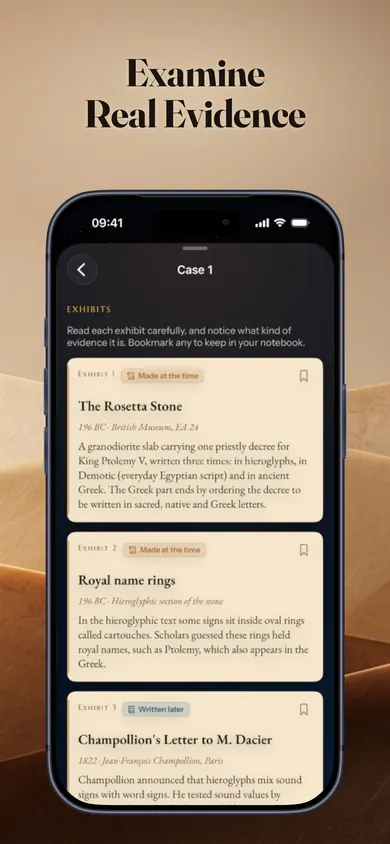
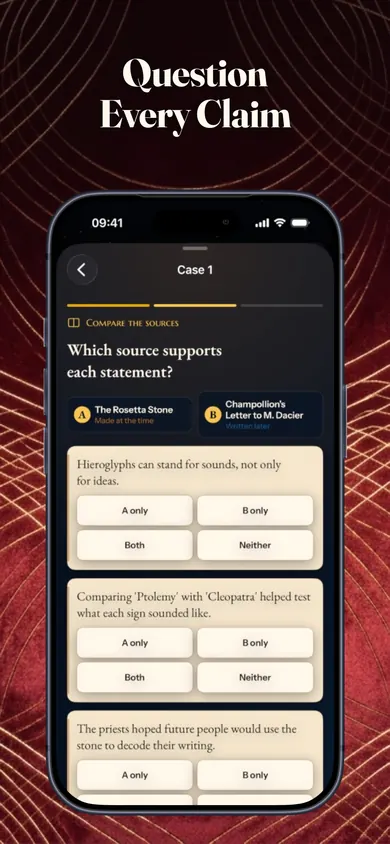
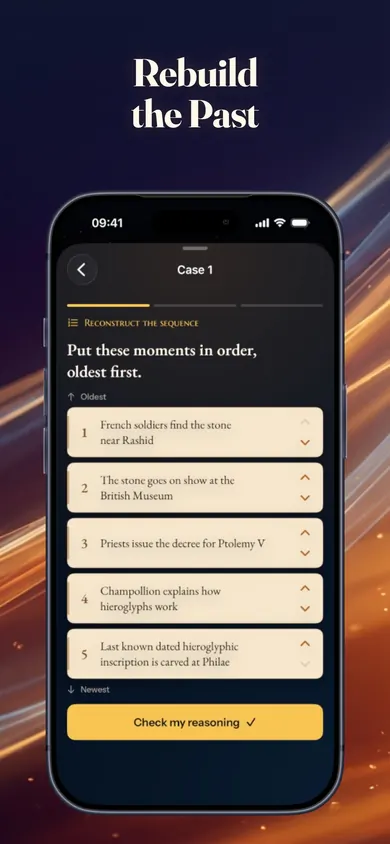
Picture an eleven-year-old with a photo from a grandparent's shoebox: three people on a beach, no date. The checklist turns "old photo" into questions. What is it? A printed photo. When was it made? Unknown, but the car in the back gives a clue. Who made it? Probably whoever was not in the picture. What can it not show? Whether anyone was having a good time.
That last question is the one children remember. A source can be real and still not tell you everything.
Real is not the same as complete.
Here are all six answers for the Rosetta Stone, using only what PastRush's Case 1 exhibits show.
| Question | Rosetta Stone answer |
|---|---|
| 1. What is it? | A stone slab, granodiorite, carrying one priestly decree. An object, not a book. |
| 2. When was it made? | 196 BC. It is labelled Made at the time: it was carved when the decree was issued. |
| 3. Who made it, and why? | Priests, to record a decree for King Ptolemy V. The Greek part even orders it to be written in three scripts. |
| 4. What does it show? | The same decree three times: in hieroglyphs, Demotic and ancient Greek. |
| 5. What can it NOT show? | How hieroglyphs sound. The stone gives no key. That came from Champollion's work, written later, in 1822. |
| 6. Does another source agree? | Champollion's 1822 letter to M. Dacier tested sound values using royal names like Ptolemy. Two sources, two kinds of evidence. |
A Primary Source Analysis Tool built on observe, reflect and question, with teacher guides for photos, maps, cartoons and more. Library of Congress guides
Document analysis worksheets for photos, maps, artifacts and more, at novice and intermediate levels, in the public domain. National Archives worksheets
One page, six fixed questions for any source, the four PastRush evidence labels and a worked Rosetta Stone example. Made by us.
Use ours to start the habit. Use theirs to go deeper.
Something made at the time you are studying, by people who were there: a letter, a photo, a carved stone, a diary, a map. A secondary source is made later by someone looking back, like a textbook.
We wrote it for roughly 9 to 13, upper elementary and middle school. Younger children can do questions 1, 2 and 4 out loud with an adult.
Yes. No email, no sign-up. Print as many copies as you need for your family or class.
Theirs are excellent and free, and we link both. Ours is shorter, uses one fixed set of six questions for every kind of source, and adds the four evidence labels used in PastRush.
In spirit. Every PastRush exhibit carries a label (made at the time, written later, scientific finding or modern reconstruction), and its challenges ask what each source supports and what neither shows.
A Daily Evidence Check gives five claims to judge every day. Six cases are free, with no account, ads or tracking.

Make it a habit with PastRush on the App Store
Updated November 2026