
How do you count years from BC to AD?
Add the BC year and the AD year together, then subtract one, because the calendar goes straight from 1 BC to AD 1 with no year zero. From 500 BC to AD 500 is 999 years, not 1,000.
That is the whole rule. The rest of this page shows why it works, when you do not need it, and a calculator that does it for you. We wrote it because PastRush, our history detective game, asks players to rebuild the order of events with BC and AD dates handled correctly, and this is the step people trip on most.
Honest limits of the minus-one rule
- Whole years only. The rule counts calendar years. If one event happened in March and the other in October, the true gap can be a year either side.
- Old dates are often approximate. "About 3300 BC" plus AD 2026 minus one is still about. Do not add precision the source does not have.
- Astronomers count differently. Their year numbering has a year zero (1 BC is year 0), so plain subtraction works for them. Use the history rule for history homework.
- Calendar changes are a separate puzzle. Julian and Gregorian dates can differ by days; this page does not adjust for that.
The minus one fixes the calendar, not the evidence.
Where BC and AD dates show up in PastRush
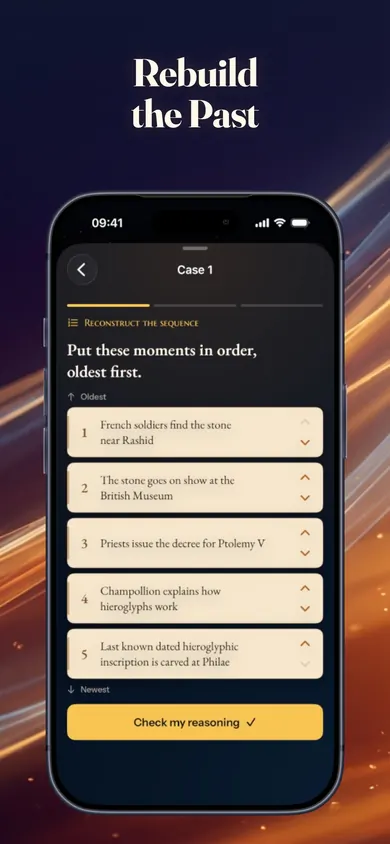
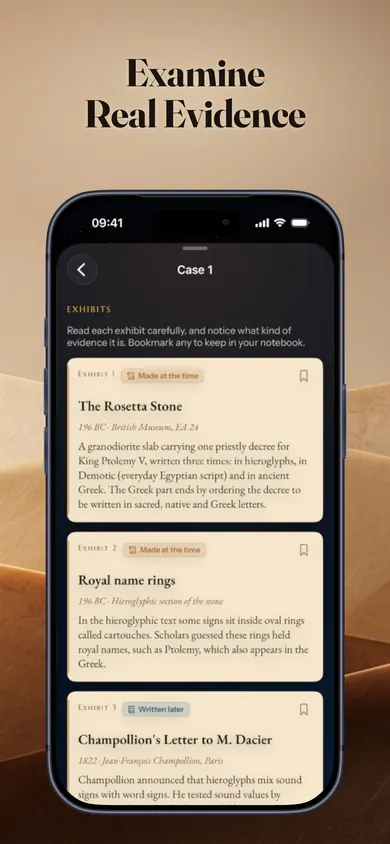
App Store screenshots from Case 1. The chronology step asks you to put moments in order, oldest first, spanning 196 BC to the 1800s.

BC to AD year calculator
Enter two years. The calculator picks the right rule and shows the working.
Worked results from PastRush exhibits
- 1Write both dates with their labels
196 BC and AD 1822. The Rosetta Stone decree and Champollion's letter, two exhibits from PastRush's first case. Never drop the BC or AD; it decides which rule you use.
- 2Same side of the line? Just subtract
If both are BC, or both AD, subtract the smaller from the larger. 1822 - 79 = 1,743 years from Pompeii's eruption to Champollion. No trick needed.
- 3Crossing the line? Add the two numbers
196 + 1822 = 2,018. That counts how far each date sits from the BC/AD line.
- 4Subtract one for the missing zero
2,018 - 1 = 2,017 years. The calendar jumps from 1 BC straight to AD 1, so adding counted one year that does not exist.
Same side: subtract. Across the line: add, then minus one.
BC and AD questions
How many years between 500 BC and AD 500?
999. Add the two numbers (1,000) and subtract one, because the calendar goes straight from 1 BC to AD 1 with no year zero.
Why is there no year zero?
The AD system was set up in the 500s, before zero was used as a number in Europe, and it starts at AD 1. When BC numbering came into common use later, 1 BC was placed directly before AD 1. Historians have never included a year zero.
How do I count years between two BC dates?
Subtract the smaller number from the bigger one. From 300 BC to 196 BC is 104 years. No adjustment is needed, because year zero only matters when you cross from BC to AD.
How long ago was a BC date?
Add the BC year to the current year and subtract one. In 2026, 196 BC was 196 + 2026 - 1 = 2,221 years ago.
Are BCE and CE counted the same way?
Yes. BCE and CE are the same years as BC and AD with different names, so the same rule applies: add, then subtract one.
Do astronomers use a year zero?
Yes. Astronomical year numbering, introduced by Jacques Cassini in 1740, calls 1 BC year 0 and 2 BC year -1. In that system you can subtract normally. Historians do not use it.
Is the minus one always exact?
It is exact for whole calendar years. For real events it can be off by one either way, depending on the months. If one event was in March and the other in October, say about, not exactly.
History of the numbering (Dionysius Exiguus in 525, Bede in 731, Cassini's astronomical years in 1740) from the Year zero article on Wikipedia, checked November 2026.
Who PastRush is not for
- Students who need a full course with a syllabus and grades. PastRush is 12 investigations plus quick games, not a curriculum.
- Anyone who wants every case free. Six investigations are free; six more, every story collection and the Master tier come with Founder Lifetime, a one-time purchase.
- Android users. It is on iPhone and iPad only.
How to never get it wrong again, in 3 steps
- Check the labels. Same era, or one BC and one AD?
- Pick the rule. Same era: subtract. Different eras: add.
- Fix the zero. Crossed the line? Take one away.
One design decision we made in PastRush: Which Came First? leaves out dates historians still debate, so every round has one right answer and you are practising the counting, not guessing at a dispute.
Download free on the App Store
Rebuild the past in order, oldest first, with BC and AD dates in the mix. No account, no ads, no tracking.

Download PastRush free on the App Store
Updated November 2026
Related
- PastRush: the history detective game with real evidencePastRush is a history detective game: order events, weigh sources and decide what evidence proves. Six cases free on iPhone, no ads, no account.
- Primary source checklist for kids (free printable)A one-page primary source checklist for kids aged 9 to 13: six questions, four evidence labels and a worked Rosetta Stone example. Free PDF.
- History apps for homeschool middle school: questions answeredWhich history apps actually teach middle schoolers to weigh evidence? Answers for homeschool parents, a weekly-minutes planner and an honest comparison.
- Winter break screen time ideas for middle schoolersTwo weeks off and the tablet never sleeps? Pick your family's situation for a realistic screen plan, with CDC and Mayo Clinic guidance for parents.