How do you solve a number path puzzle?
Solve number path puzzles by deciding the forced parts first: corners, cells with only one way in, and the ending, then let the number rule tell you where each segment must stop. Guessing a long line and hoping is what produces the dead end with one lonely cell left. These six checks work on Zip-style grids, Hidato and our own game, Sumthread, where the path has to hit ordered target sums.
Forced cells first, numbers second, guessing last.
The 6 number path puzzle tricks, step by step
- 1
Add up the whole board
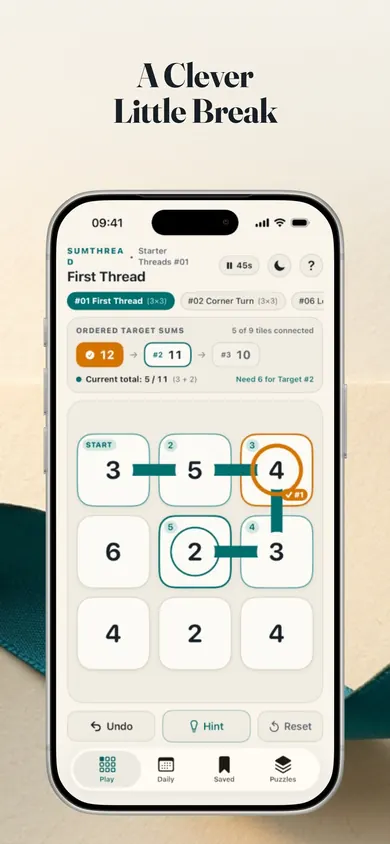
In a sum-path puzzle every tile gets counted once, so all tiles together must equal all targets together. First Thread: 3+5+4+6+2+3+4+2+4 = 33, and 12+11+10 = 33. If you ever feel a target is impossible, this tells you the board is fine and your route is not.
- 2
Colour it like a chessboard
Every move up, down, left or right changes colour. A 3x3 board has five "corner-colour" cells and four others, so a path through all nine must start and end on the corner colour. START is a corner, so the thread ends on a corner or the centre. Four of the nine cells can never be the finish.
- 3
Respect the corners
A corner has two neighbours. If it is not the start or the end, the path must come in through one and leave through the other. On First Thread, that means the top-right 4 links the 5 and the 3 below it, unless the thread ends there.
- 4
Treat overshoot as a wall
Tile values are all positive, so a running total only grows. The moment a segment passes its target, that whole branch is dead. From START, 3 + 6 = 9 is fine, but 3 + 6 + 4 = 13 already overshoots 12, so the left column cannot be your first segment.
- 5
Check for stranded tiles every few moves
Any unvisited tile with just one unvisited neighbour has to be the final tile. If you see two of those at once, back up now: you cannot end in two places.
- 6
Back up to the last checkpoint, not the start
A locked target is a fact. When a segment fails, rewind only to the last amber ring and try the other neighbours from there. In Sumthread you drag backward or tap an earlier tile on your path, and the thread unwinds without penalty.
Two of the six tricks need no arithmetic at all: corners and chessboard colours.
Number path puzzle types compared
| Puzzle | Moves | What the numbers do | Best first trick |
|---|
| Hidato / Hidoku | 8 directions, diagonals allowed | Fill in a consecutive count, 1 to N | Find gaps between given numbers |
|---|
| Zip-style | Up, down, left, right | Visit numbered dots in order | Corners and chessboard colours |
|---|
| Sumthread | Up, down, left, right | Running total must hit ordered target sums | Board total, then overshoot |
|---|
Diagonal moves break the chessboard trick, so save it for four-direction grids.
Questions about number path puzzles
What is a number path puzzle?
A grid puzzle where you draw one continuous line through the cells, usually visiting every cell once, while meeting a number rule: consecutive numbers (Hidato), numbered dots in order (LinkedIn Zip) or, in Sumthread, ordered target sums.
Why do I keep getting stuck with one cell left over?
You almost always stranded it earlier. A cell with only one unvisited neighbour left has to be the last cell of the path. Check for those after every few moves, not at the end.
Is there a trick that works on every grid?
Colour the grid like a chessboard. Each move switches colour, so on a board with an odd number of cells, a path that covers everything starts and ends on the colour that has one more cell. That rules out half the endings at a glance.
Do I have to use every tile in Sumthread?
Yes. The single path must pass through every tile, moving up, down, left or right, with no diagonals and no revisits, and the final target sum must finish on the last remaining tile.
Do hints count against me in Sumthread?
You can use Hint, Undo and Reset whenever you like. Only the Clean Weave seal asks for zero hints and zero undos on a board.
Which board should I practise on first?
Starter Threads, the 3x3 collection. The first board, First Thread, has targets 12, 11 and 10 and is the one worked through on this page.
Honest limits
These tricks narrow the options; they do not replace trying routes. On the 4x5 Grand boards you will still back up a few times, and that is the puzzle working as intended. Sumthread itself has limits worth knowing: boards top out at 4x5, there is no global leaderboard, and it runs on Apple devices only (iOS 18 or later). It is a free download with no ads and no account, and its App Store page lists no in-app purchases.
One design decision we made: the app shows dashed borders on tiles you can reach next and amber marks on tiles that would complete the current target. Some players want it harder, so step-order badges and contrast borders are optional, and the Clean Weave seal rewards solving without hints or undos.
Who should pick something else: if you want huge grids or diagonal moves, a Hidato app will suit you better.
A mini story: Corner Turn in four moves
The second board, Corner Turn, has targets 9, 12, 12. Total check: 4+3+6+2+5+1+3+4+5 = 33, and 9+12+12 = 33. Good.
From START (4), the obvious move right to the 3 gives 7, and then the 6 overshoots. So we go down instead: 4, then 2, then the bottom-left 3. That is 9, and the corner locks with an amber ring. Count resets to zero.
Next, along the bottom to the 4, up to the 5, up to the 3: 4 + 5 + 3 = 12. Locked. Three tiles remain, the right column: 6, 1, 5. That is exactly 12, and the thread finishes on the last tile, bottom-right, a corner, just as the chessboard trick predicted.
Total, overshoot, corners: three checks solved the whole board.
Open Sumthread in the App Store
Try First Thread with the six tricks next to you. It takes about a minute.

Open Sumthread in the App Store · Updated November 2026