What are good math games to play with grandchildren?
The best math games to play with grandchildren are short, turn-taking games about making ten, played side by side, where the grown-up asks "what happens next?" instead of "what's the answer?". Make-ten is the backbone of early arithmetic, and it works with fingers, cards or a puzzle.
The University of Chicago's Becoming a Math Family project describes a game called Breaking and Making 10: one player shows some fingers, the other shows how many more make ten, and you count together to check. It suggests looking for patterns as you go. A NAEYC family guide by Jessica Mercer Young and Kristen E. Reed makes a related point: when children count on their fingers, "they are strengthening their number knowledge", and puzzles help them think about spatial relationships.
That is why our week starts with fingers on Monday and only brings the phone in on Tuesday.
Ask "what happens next?", not "what's the answer?"
Grandparent questions, answered first
What math games can grandparents play with grandchildren?
Start with games that need nothing: the University of Chicago's Becoming a Math Family site suggests Breaking and Making 10 with fingers for ages 4 and up. Card games, dice and board games work too. A puzzle app is one option among these, best played side by side rather than handed over.
What age is Number Beasts for?
The App Store listing does not give a target age; it describes large readable numbers and two-step tap-to-aim. In practice it suits children who can add within 10, often around 5 to 8, and the later worlds challenge adults.
Is Number Beasts safe to give a grandchild?
The listing says no ads, no accounts, no tracking and no in-app purchases, and everything is stored on the device. There is nothing to buy by accident and no chat.
Can we play together if we live in different towns?
Yes, without accounts. In Beast Workshop you build a board, press Prove, and share it as a short code. The other person pastes the code and plays the exact same board.
I'm not good with apps. Is it hard to set up?
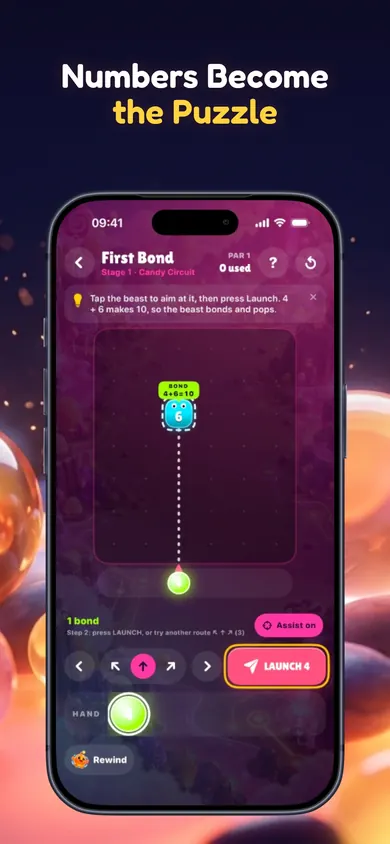
There is no sign-up. Download it, open it, and Stage 1 explains itself: tap the beast to aim, then press Launch. Large numbers and VoiceOver labels are built in.
Does it work without Wi-Fi?
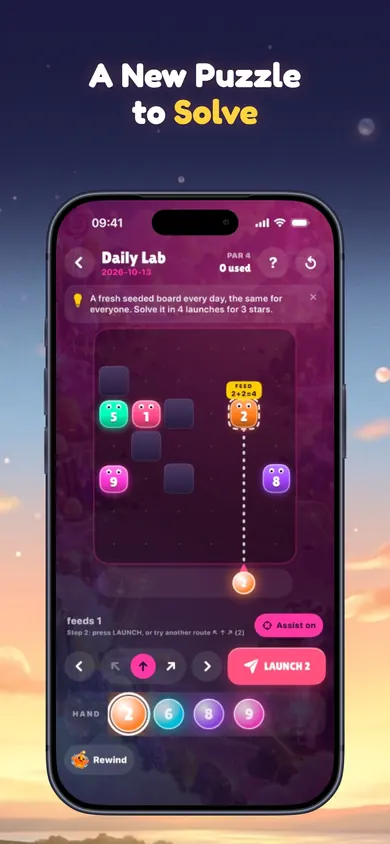
Yes. The whole game works offline, including the Daily Lab, which is made on the device.
What the first sessions look like on the screen
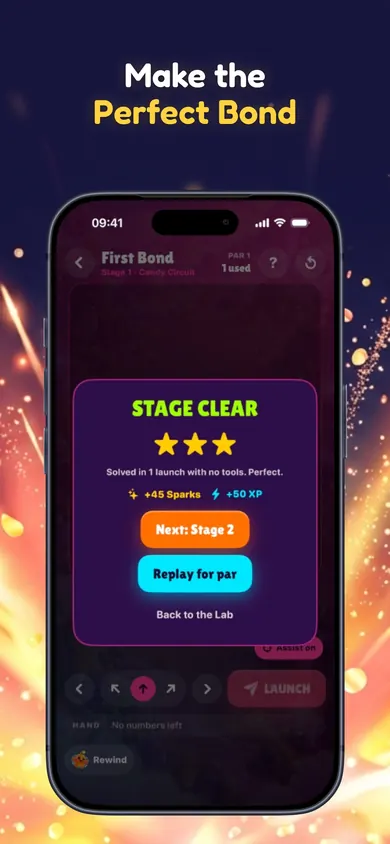
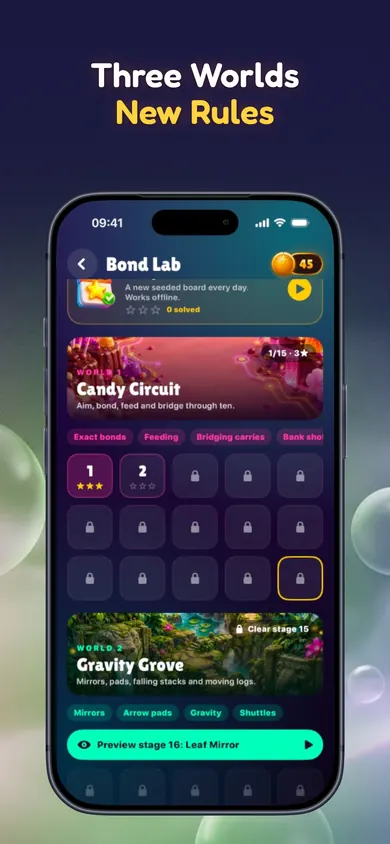
Store screenshots. Each one is a stage you will meet in the first week.
How the first week works, in 3 steps
- Fingers before phones. Monday is Breaking and Making 10 with hands only. It teaches the idea the app is built on.
- One phone, two players. From Tuesday, one of you aims and the other says what will happen: bond, feed, or bridge with a leftover. Then launch and see.
- Trade puzzles. By the weekend, build a board in Beast Workshop and share its code. It is a reason to call each other that is not "how was school?".
The week at a glance
- Mon · Play Breaking and Making 10 with fingersNo phone at all. You show some fingers, they show how many more make ten. Swap.
- Tue · Install Number Beasts, play Stage 1 togetherSit side by side. Let them tap the beast; you read the hint aloud.
- Wed · Turn aim assist off for one stageNow the path and the sum stop appearing. Ask: what will that 7 do to the 5?
- Thu · Say the leftovers out loudA 7 into a 5 pops it and 2 carries on. Make the 2 a joke character.
- Fri · Do the Daily Lab togetherOne fresh board, the same day for both of you. Compare launches, not scores.
- Sat · Build a board in Beast WorkshopLet them design one for you. Press Prove; only solvable boards save.
- Sun · Swap the code by textShare the board as a short code. They solve yours at home; you solve theirs.
One design decision we made: hero tools (rewind, nudge by one, reveal a move) are always there, but any tool caps a stage at two stars. A child can ask for help without being told off, and three stars still means something.
Who Number Beasts is not for
- Toddlers. Aiming, then launching, then reading the result is a lot for a three-year-old. Fingers and blocks are better.
- Times-table practice. The core is making 10. Chaos Laboratory adds converters and beasts that need 15 or 20, but it is not a multiplication drill.
- Android households. It is an iPhone app; there is no Android version.
- Quiet solo screen time. It works alone, but this guide is about playing together. If the goal is a babysitter, pick something else.
Monday is fingers. Tuesday is beasts.
Free, with no ads, no accounts and no purchases, so there is nothing to supervise on the money side.

Updated November 2026
Related
- Number Beasts: the make-ten number bond puzzleLaunch a number, make 10, carry the rest. A turn-based number bonds puzzle for iPhone with 45 stages. No ads, no purchases, offline.
- Best number bonds app for kids: 4 comparedA parent's guide to four iPhone and iPad number bonds apps: price, ads, sums covered, progress tracking. Three taps match one to your child.
- What to do when your child still counts on fingersFinger counting is a normal stage. Pick your child's situation for the next step to try, from counting on to make-ten games, with sources.
- Math games instead of worksheets: which swap fitsWhen worksheets end in tears: compare a card game, a shorter sheet and a make-ten puzzle app, then take a 3-question quiz to pick one.