How do you teach number bonds in homeschool?
Teach number bonds with real objects first, then part-part-whole drawings, then quick games, spending about a week on each step. Your child should see that 7 and 3 make 10 with counters before saying it from memory. A game comes last, as practice, not as the lesson.
In one line: hands, then pictures, then play.
How it works in 3 steps
Ten counters in a ten frame. Cover some, ask how many are hiding.
A bond diagram: 10 in the top circle, 7 and 3 in the two below.
Launch numbers at beasts that pop at exactly 10. Planning, not speed.
The four-week number bonds timeline
- Week 1
Counters and the ten frame
Ten objects on the table, every day. Your child hides some under a cup and you say the hidden number together. This matches Common Core standard K.OA.A.4: find the number that makes 10 using objects or drawings.
Parent tip: use the same ten objects all week. New objects make it a new task.
- Week 2
Bond diagrams and talk
Draw a whole circle with 10 and two part circles. Fill one part, your child fills the other. Say the sentence aloud: "6 and 4 make 10, 4 and 6 make 10."
Parent tip: the calculator above makes good talk prompts. Set a beast to 6 and ask what to launch before you tap.
- Week 3
Candy Circuit with aim assist on
Open Number Beasts and play the first world together. With aim assist on, the full path and the exact sum (for example BOND 4+6=10) appear before your child presses Launch, so the game checks the thinking from week two.
Game tip: ask your child to say the bond before they look at the preview. The preview then confirms, rather than tells.
- Week 4
Feed and bridge: past ten
Now the leftovers. Launch 7 into a 5 and the beast pops while 2 carries on. That is the same idea as standard 1.OA.C.6's making-ten strategy: 8 + 6 = 8 + 2 + 4 = 10 + 4.
Game tip: once stages feel easy, switch aim assist off for pure planning. Hero tools still help, but any tool caps the stage at two stars.
Four short weeks, one idea each: hold, draw, play, carry.
Ways to practice number bonds at home, compared
What your child sees on screen
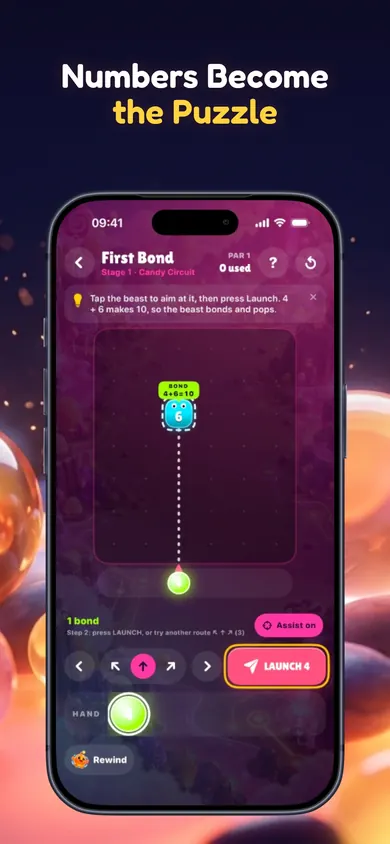 aim preview shows the bond
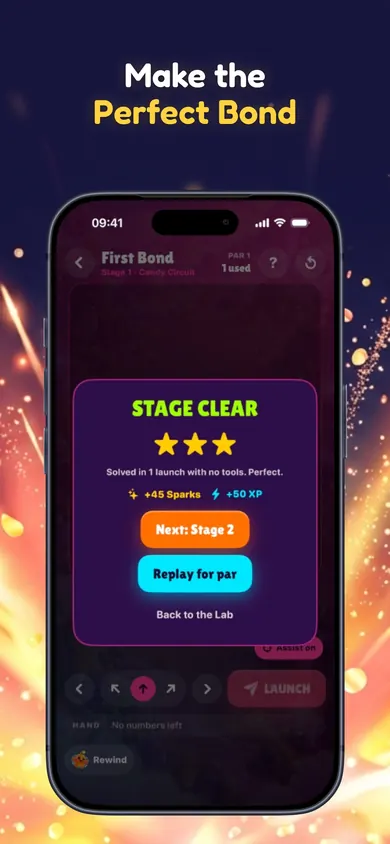 3 stars = at par, no tools
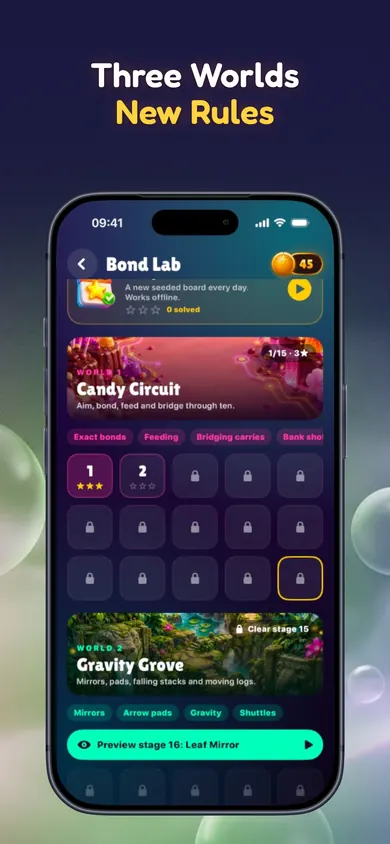 week 3 starts here
Who this plan is not for
- Children still learning to count ten objects one by one. Stay in week 1 as long as needed.
- Families avoiding screens in the early years: the dice and card games cover the same ground.
- Parents who want a per-fact progress report from the puzzle stages. Only the arcade mode's Bond Map tracks bonds played.
A Tuesday at the kitchen table
Ten buttons, one mug. Your daughter hides three, you guess seven, she laughs because you guessed wrong on purpose. On paper she fills the empty circle with a 3. Then, as the treat, Stage 1: one beast showing 4. She says "six" before the preview appears, launches, and it pops. Total time: twelve minutes. The worksheet stayed in the folder.
One design decision we made for moments like this: the puzzle stages are turn-based, so nothing hurries the next launch. A child who stops to think is doing the work, and the game waits.
Homeschool number bonds questions
At what age do kids learn number bonds to 10?
In the US, Common Core standard K.OA.A.4 asks kindergartners to find the number that makes 10 with any number from 1 to 9, using objects or drawings. In first grade, standard 1.OA.C.6 expects fluency within 10 and lists making ten as a strategy for sums within 20.
How long should a homeschool number bonds lesson be?
For five and six year olds, ten to fifteen minutes is plenty: five minutes with objects, five minutes of talk or drawing, and an optional few minutes of a game. Stop while it is still going well.
Should I teach number bonds with flash cards?
Flash cards test recall, which matters later. Start with objects and drawings so your child sees why 7 and 3 make 10, then use quick recall practice once the pairs make sense.
Is Number Beasts free?
Yes. The listing says no ads, no accounts, no tracking and no in-app purchases, and the whole game works offline.
Can a child who cannot read yet play Number Beasts?
With you beside them, yes. The numbers are large and the launch preview shows the sum, but stage tips are written text, so pre-readers need an adult to read the first tips aloud.
What do FEED and BRIDGE mean in Number Beasts?
FEED means the launched number fell short of 10, so the beast grows and now needs a smaller number. BRIDGE means it went past 10: the beast pops and the leftover keeps flying to the next beast.
Does Number Beasts track which bonds my child knows?
The arcade mode has a Bond Map that tracks every number bond played there. The puzzle stages record stars and par, not a per-fact report.
Get Number Beasts free
Save it for week three. Get Number Beasts free now so it is ready when the counters have done their job.

Get Number Beasts free on the App Store
Updated November 2026
Related
- Number Beasts: the make-ten number bond puzzleLaunch a number, make 10, carry the rest. A turn-based number bonds puzzle for iPhone with 45 stages. No ads, no purchases, offline.
- Best number bonds app for kids: 4 comparedA parent's guide to four iPhone and iPad number bonds apps: price, ads, sums covered, progress tracking. Three taps match one to your child.
- What to do when your child still counts on fingersFinger counting is a normal stage. Pick your child's situation for the next step to try, from counting on to make-ten games, with sources.
- Make 10 card game: rules and a daily puzzleHow to play the Make 10 card game with one ordinary deck: setup, 3 family versions, a new card puzzle every day, and where an app fits.