What does a claim-evidence-reasoning example in history look like?
A history CER makes an arguable claim about the past, cites specific sources as evidence, and explains why those sources support the claim and where they stop. The difference from science is the evidence: you are not measuring, you are weighing sources made at the time against sources written later. The slider above is our worked example, built on a question that historians really do argue about.
A fact answers “what”. A claim answers “what, probably, and how do we know”.
A Tuesday night, one seventh-grade assignment
The prompt says: “When was Pompeii destroyed? Write a CER paragraph.” A quick search gives 24 August, AD 79. The paragraph is done in four minutes. It is the “before” answer above.
A parent reads it and asks one question: “Who says August?” Nobody knows. That date turns out to rest on copies of letters by Pliny the Younger, written about twenty years after the eruption, according to Archaeology magazine (October 2018).
Same article: in 2018 archaeologists reported a charcoal inscription in Pompeii with a date that corresponds to 17 October, and officials pointed to autumn fruit and heating braziers in the ruins. They suggested 24 October instead.
Now there is something to argue. The new paragraph makes a claim, names two kinds of evidence, and says honestly what the inscription cannot show. It takes forty minutes, not four, and it is the first one that sounds like history.
How to teach claim, evidence and reasoning in history: 3 steps
- Pick a question with two defensible answers. “When was Pompeii buried?” works; “Who was the first emperor?” mostly does not. If every source agrees, there is nothing to reason about.
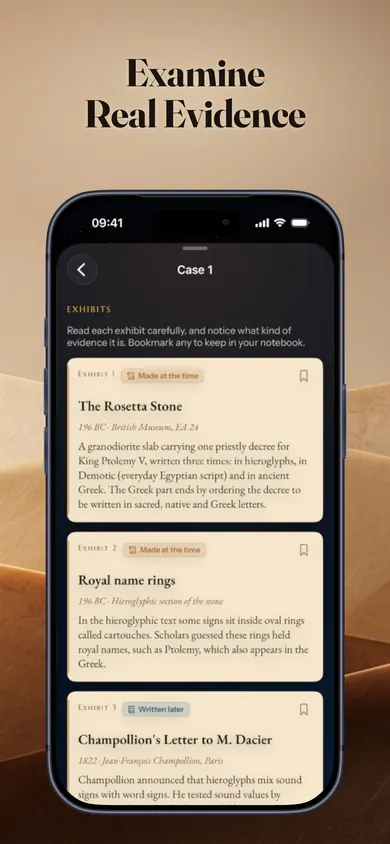
- Label every piece of evidence before using it. Made at the time, written later, scientific finding or modern reconstruction. PastRush labels each exhibit exactly this way, because the label changes how much weight it can carry.
- Make the reasoning name a limit. Strong history reasoning says why the evidence supports the claim and where it runs out. “It gives no year” is not a weakness in the paragraph; it is the paragraph doing its job.
Honest limits of using an app for this
- PastRush practises the thinking; it does not write the paragraph. Students still need to put CER into their own sentences.
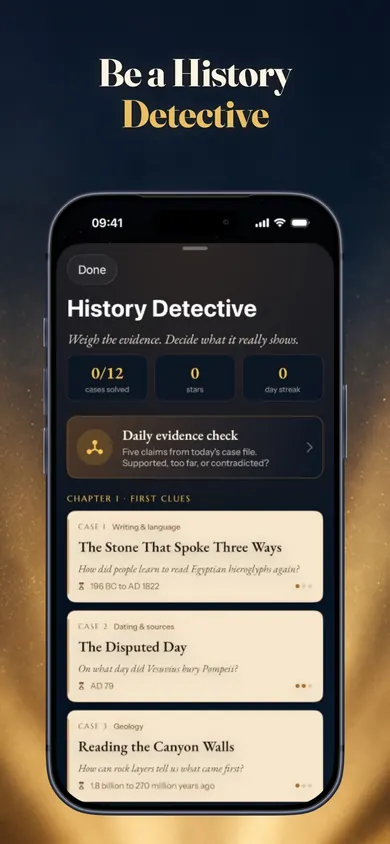
- Six of the twelve cases are free, Pompeii and the Rosetta Stone among them. The other six need the one-time PastRush Pro Lifetime purchase, $99.99 on the App Store today.
- The story pictures are AI-assisted illustrations and are labelled as illustrations, never presented as photographs.
- Maps and satellite views need an internet connection. Cases and the Notebook work offline.
Try it: supported, or going too far?
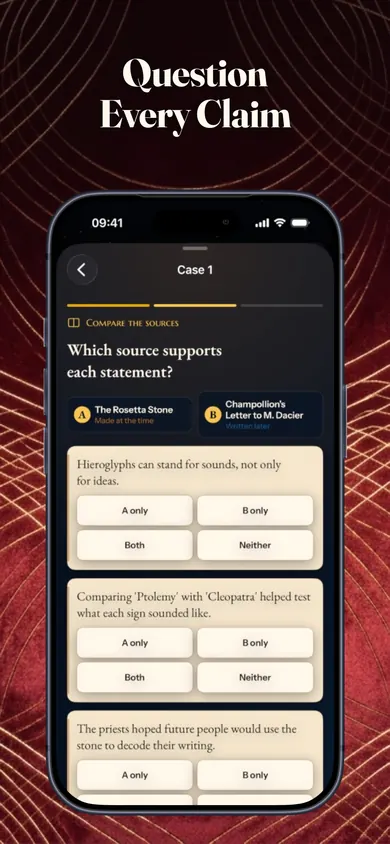
This is the skill PastRush's “What can we conclude?” rounds train. Four statements about Pompeii; sort each one.
Pompeii was buried on 24 August AD 79, end of story.
A charcoal inscription found at Pompeii records a date equal to 17 October.
The inscription proves the eruption was on 24 October AD 79.
Autumn fruit and heating braziers found in the city fit an autumn eruption.
0 of 4 sorted.
CER in science vs CER in history
Science
Claim answers a testable question.
Evidence is data you measured or observed.
Reasoning links data to a scientific principle.
History
Claim answers a question sources can argue about.
Evidence is sources, labelled by when and how they were made.
Reasoning weighs reliability and names what the sources cannot show.
Same three letters, different hard part: in history, the hard part is trusting the evidence.
The same skills inside PastRush
Who this is not for
If you need a ready-made CER worksheet with a rubric for a whole class tomorrow, a printable will serve you better than an app. If your students are under 9, the App Store's 9+ rating and the reading load suggest waiting. And if you want a full history curriculum, PastRush is twelve deep cases, not a textbook.
One decision we made on purpose: in “Which Came First?” we leave out dates that historians still debate, so every round has one right answer. The debates belong in the cases, where students can weigh them.
CER in history: common questions
What is a claim evidence reasoning example in history?
A short paragraph that makes an arguable claim about the past, backs it with specific sources, and explains why those sources support the claim and where they stop. Our worked example asks when Vesuvius buried Pompeii.
How is CER different in history and science?
In science, evidence is usually data you collected. In history, evidence is sources: things made at the time and things written later. The reasoning step has to weigh how reliable each source is, not only what it says.
What grade is CER taught in?
It varies by school and subject; many teachers meet it first in middle school science or social studies. Your own standards and curriculum are the place to check.
What is a good claim for a history CER?
One that a reasonable person could disagree with and that your sources can test. “Pompeii was destroyed in AD 79” is a fact; “The eruption most likely happened in autumn, not August” is a claim.
Is PastRush free?
Six investigations, including Pompeii, are free with no ads, no account and no tracking. Six more come with a one-time purchase that the App Store lists as PastRush Pro Lifetime at $99.99 (the app description calls it Founder Lifetime). There is no subscription.
Can I use PastRush with a class?
Class mode hides purchases and outside links on shared devices. It does not open the paid cases. Progress and notes stay on each device.
Was Pompeii really destroyed in October?
Nobody can say for certain. Copies of Pliny's letters point to 24 August; a 2018 inscription and autumn finds point later, and 24 October has been proposed. That open question is exactly why it makes a good CER exercise.
Get PastRush free
Open the Pompeii case tonight and argue about a date that is still being argued about.

Get PastRush free on the App Store
Updated November 2026
Related
- PastRush: the history detective game with real evidencePastRush is a history detective game: order events, weigh sources and decide what evidence proves. Six cases free on iPhone, no ads, no account.
- History activities before winter break: a 5-day planA 5-day history detective plan for the last week before winter break: 15-20 minutes a day, real evidence, a chronology warm-up you can run today.
- How to fact-check history videos in 5 questionsHeard a history 'fact' in a video? Five questions catch most myths before you repeat them. Four real myths flipped, with museum and journal sources.
- History apps for homeschool middle school: questions answeredWhich history apps actually teach middle schoolers to weigh evidence? Answers for homeschool parents, a weekly-minutes planner and an honest comparison.