How do you make a museum visit fun for kids?
Give kids one job before you walk in: find the objects that were really there, catch the ones that are replicas, casts or reconstructions, and tell you the story of their favourite. A job turns "don't touch" into a hunt, and the hunt ends when the job is done.
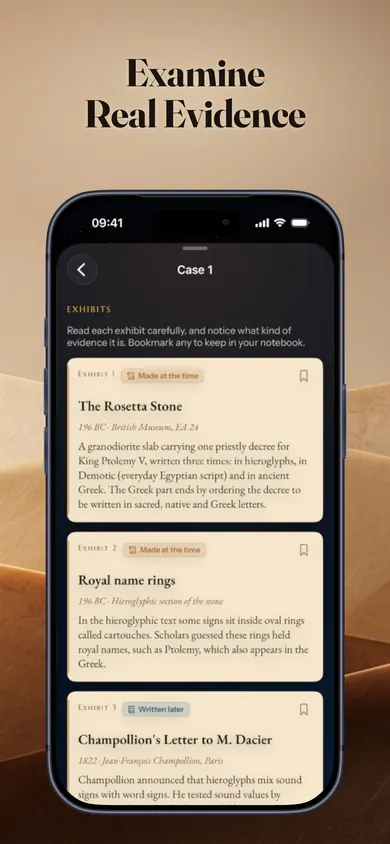
The label game above is that job in practice. It uses the four evidence labels from PastRush, which we make: made at the time, written later, scientific finding and modern reconstruction. Museum labels use different words, but they answer the same question: who made this, and when?
The Smithsonian's family museum tips point the same way: talk about what you will see before the first visit, be flexible and follow your child's lead, and ask your child to tell you a story about an object that interests them.
A kid with a question walks slower past the glass.
How to run a museum label hunt, in 3 steps
- Before
Play one round at home
Ten minutes the night before. Play the label game, pick one gallery together on the museum's website, and agree a meeting spot in case you get separated, as the Smithsonian suggests.
- During
Hunt for three
Your child finds three objects: one original, one replica or reconstruction, and one they simply like. They read the label out loud and say which kind it is. You follow, not lead.
- After
The story at dinner
They tell the family about their favourite object in three sentences: what it is, who made it and when, and one thing it can't tell us. That last part is the detective habit.
Before, during, after: ten minutes, one hour, three sentences.
Free museum days near you
Before you pay, check three things:
- The museum's own free days. Many museums set aside free evenings or community days; their website will say.
- Museums on Us. Bank of America, Merrill and Bank of America Private Bank card holders get one free general admission on the first full weekend of each month at participating museums. Event listings show Saturday 7 to Sunday 8 November and Saturday 5 to Sunday 6 December 2026. It covers the cardholder only and excludes special exhibitions, so check the official list before you go.
- Always-free museums. If you are near Washington, DC, the Smithsonian museums charge no admission.
Honest limits
- The game simplifies. Real objects can be two things at once: a plaster cast is made later but shaped by something real. Treat a "wrong" answer as a good argument, not a failure.
- Labels vary. Art museums talk about materials, natural history museums about specimens. The question still works; the words change.
- PastRush is not free all the way. Six cases are free. Cases 7 to 12, every story collection and the Master tier come with one purchase, listed on the App Store as PastRush Pro Lifetime at $99.99. It is one-time and works with Family Sharing.
- One design decision we made: every exhibit in the app carries one of the four labels, and illustrations are marked as AI-assisted illustrations, never passed off as photos of real objects. The point is to practise the question you ask at the glass.
Museum activities for kids, compared
Audio guide
Rich detail, but kids drift. Best for 11 and up.
Printed scavenger hunt
Fun, but often "find a red vase": seeing, not thinking.
Label hunt
Three objects, one question: original or made later? Works in any history museum, costs nothing.
Museum family trail
Made for that building. Grab one at the desk if they have it, and add the label question.
Who this guide is not for
- Toddlers and preschoolers. They need touching, running and snacks, not labels. A children's museum is the better day out.
- Families after a ready-made printable. This is a habit, not a worksheet. Your museum's own family trail will be more tailored.
- Kids already deep in a topic. A dinosaur expert does not need a game. Let them lead the whole visit.
Museum questions parents ask
How do you keep kids interested in a museum?
Give them a job and a short visit. One question to answer (which things here are originals?), three objects to find, and an exit before they fade. The Smithsonian's family tips say to follow your child's lead and ask them to tell you a story about an object they like.
How long should a museum visit with kids be?
Shorter than you think. Plan for one gallery or about an hour, and leave while they are still curious. You can come back.
What is the difference between an original and a replica in a museum?
An original is the real object from the time. A replica, cast or reconstruction was made later to show what something looked like. Good labels say which one you are looking at; look for words like replica, cast, copy or reconstruction.
Are there free museum days near me?
Many museums run their own free days, so check their websites. Bank of America's Museums on Us gives its cardholders one free general admission on the first full weekend of each month at participating museums; listings show 7 to 8 November and 5 to 6 December 2026. The offer covers the cardholder only, so children may still need tickets.
What age is the label game for?
About 8 and up, since it needs reading. Younger kids can play it with you reading the cards aloud. PastRush itself is rated 9+ on the App Store.
Does PastRush work in a museum without Wi-Fi?
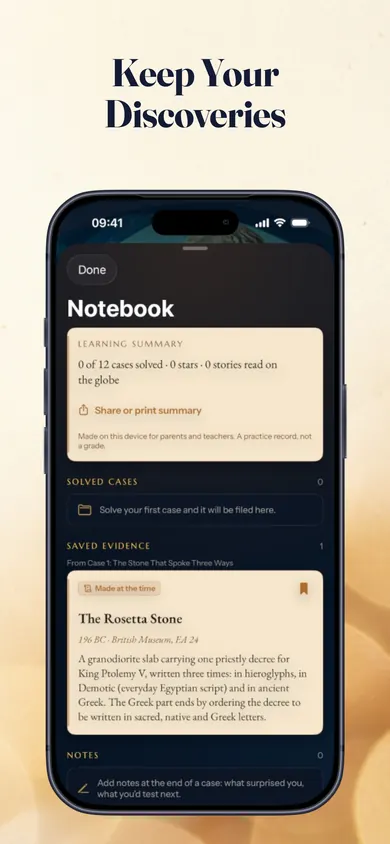
Cases, the Notebook, the stories and the Album work offline. The satellite map, Dive's satellite views, Where in the World? and nearby places need an internet connection.
Try it tonight
One free case before the museum day: the Rosetta Stone, Pompeii or Ötzi the Iceman. Then go find the real thing, or its replica.

PastRush: History Detective on the App Store · Updated November 2026
Related
- History apps for homeschool middle school: questions answeredWhich history apps actually teach middle schoolers to weigh evidence? Answers for homeschool parents, a weekly-minutes planner and an honest comparison.
- How to make history fun for kids: a 3-tap hook finderKid says history is boring? Three taps match your child to a hook (puzzles, maps, collecting or arguing) with a 15-minute activity to try tonight.
- PastRush: the history detective game with real evidencePastRush is a history detective game: order events, weigh sources and decide what evidence proves. Six cases free on iPhone, no ads, no account.
- How to fact-check history videos in 5 questionsHeard a history 'fact' in a video? Five questions catch most myths before you repeat them. Four real myths flipped, with museum and journal sources.