Holiday game night · Thanksgiving is Thursday, November 26, 2026

8 Tips for Fewer
Misplaced Timeline Cards.

For families who break out Timeline after dinner: sharpen your sense of distance first.

Cleopatra dies, 30 BC, and…

0 years apart

Tap any event to count the gap from Cleopatra.

Download PastRush: History Detective on the App StoreFree on iPhone · no ads, no account

What are the best Timeline card game tips?

Learn a handful of anchor dates, think in centuries before decades, remember that BC counts down with no year zero, and play your risky cards early while the line still has wide gaps. Those four habits do most of the work. The other four below are polish for the player who keeps losing by one card.

Timeline rewards a sense of distance more than memorized years. Few people know when the Magna Carta was sealed, but most can tell it sits between the Norman Conquest and Columbus. The counter above trains exactly that feeling: how far apart things really are.

1 Learn six anchors, one per era

Pick dates you will never forget and hang everything else on them: the Rosetta Stone decree (196 BC), Caesar's assassination (44 BC), Vesuvius (AD 79), Hastings (1066), Columbus (1492), the Moon landing (1969). A new card only has to be placed relative to the nearest anchor, which is a far easier question than “what year?”.

2 Place by century, then by decade

Decide the century first and commit. A wrong century loses the card no matter how good your decade guess was. Narrow down only when two neighbouring cards share a century.

3 BC counts backwards, and there is no year zero

200 BC is older than 100 BC. The year after 1 BC is AD 1. To find the gap across the line, add both numbers and subtract one: Rosetta Stone decree (196 BC) to Vesuvius (AD 79) is 274 years, not 275.

The BC side of the table is a mirror. Bigger numbers sit further left.

4 Play risky cards while the gaps are wide

Early in the game the line has few cards and wide slots, so a rough guess still lands. Later, every slot is narrow. Spend your uncertain cards first and save the ones you are sure of for the crowded endgame.

5 Read the technology on the card

Printed paper, gunpowder, steam, electric light, plastic. The objects in an illustration are clues to the earliest it can be. A card showing a printed book cannot sit before printing reached that place.

6 Watch the invention-versus-everyday trap

Many cards date the first appearance, not when it became common. Inventions are often older than you expect; guess earlier than your gut when a card shows a first.

7 Chain from what had to come first

If you cannot place a card, ask what it needed. A voyage needs a ship type; a treaty needs a war. Placing a card after its cause is often enough to win the slot.

8 Practise with pairs, not lists

Memorizing a list of dates fades in a week. Comparing pairs (“which came first?”) builds the relative sense the game actually tests. Five minutes a day in the week before the holiday is plenty.

Timeline is not a memory test. It is a distance test.
Who PastRush is not for

If you want the card game itself on the table, buy Timeline: PastRush is not a version of it and has no multiplayer. If your players are under 9, the App Store's 9+ rating suggests waiting. And if you just want trivia questions to read aloud, a printed list is quicker.

Honest limits

How to practise before game night in 3 steps

  1. Open Which Came First? Tap the older of two events. Five minutes, any evening this week.
  2. Check the true-scale time bar. It shows how far apart two events really are, which is the instinct tip 3 is about.
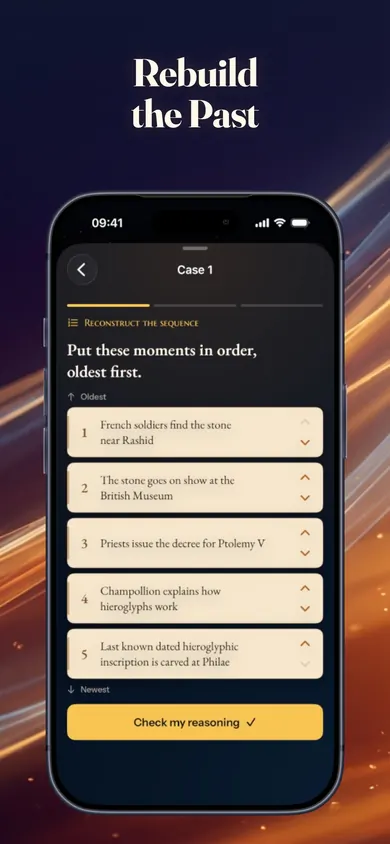
  3. Rebuild one sequence. A case's chronology round asks you to put moments in order, with BC and AD dates handled correctly.
PastRush chronology round: put five Rosetta Stone moments in order, oldest first
Chronology: put five moments in order, oldest first.
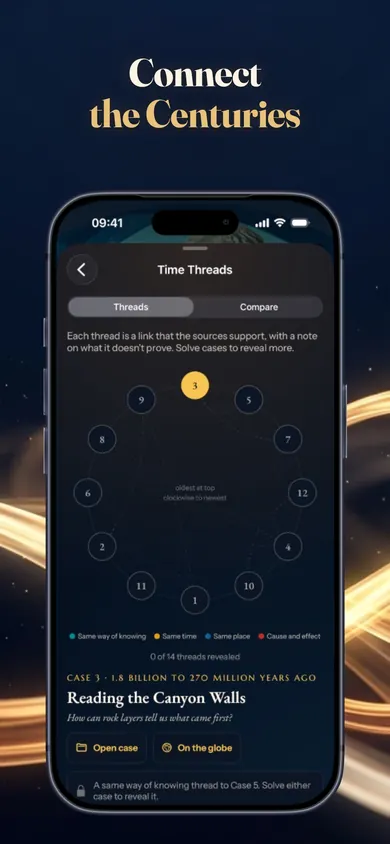
PastRush Time Threads wheel linking cases by time and place
Time Threads link solved cases by time, place or cause.
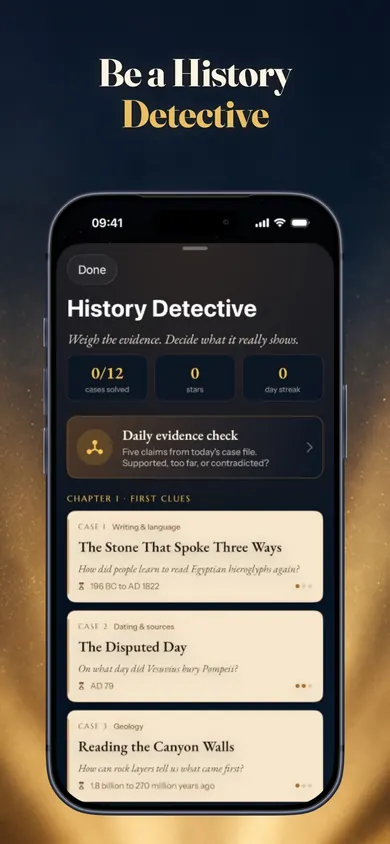
PastRush History Detective home with a daily evidence check and case list
The home screen: a daily check and the case files.

Timeline game questions

How do you play the Timeline card game?

Each card shows an event on one side and its year on the other. On your turn you place a card from your hand into the shared line where you think it belongs, then flip it. Wrong placements cost you: the card is discarded and you draw another. The first player to empty their hand wins. Check your own edition's rulebook for the exact card counts.

What is the best strategy in Timeline?

Play risky cards early, while the line has wide gaps, and keep the cards you are surest of for later, when the line is crowded and every slot is narrow.

How do you count years between BC and AD?

Add the two numbers and subtract one, because there is no year zero. From 30 BC to AD 1969 is 30 + 1969 − 1 = 1,998 years.

Is there an app to practise Timeline-style questions?

PastRush has a Which Came First? mode where you tap the older of two events. It leaves out dates historians still debate, so every round has one right answer. It is solo practice, not a version of the card game.

Is PastRush free?

Yes to start. Six investigations and the picture games are free with no ads and no account. A one-time purchase, listed on the App Store as PastRush Pro Lifetime at $99.99, adds six more cases, every story collection and the Master tier in every challenge.

What age is Timeline good for?

Check the box of your edition. For PastRush, the App Store rating is 9+.

Try it tonight

Five rounds of Which Came First? tonight, and Thanksgiving's Timeline game goes a little differently.

Download PastRush: History Detective on the App Store

Try PastRush tonight on the App Store

Updated November 2026

Related