How do you get better at logic puzzles?
You get better at logic puzzles by learning the names of the moves, then looking for forced moves and dead ends before you ever guess. Once a technique has a name, you start spotting it on every board instead of rediscovering it by luck.
In short: name it, hunt for it, then guess only when nothing is forced.
Logic puzzle terms, compared across puzzle types
The same few ideas show up under different names. This strip shows the move each family leans on most, so the glossary below carries over to puzzles you already play.
Learn forced moves once and you have the core skill of four puzzle families.
The glossary: 12 logic puzzle terms for beginners
Tap a term in the board above to jump here. Terms are in the order you usually meet them on a first board.
- Thread (path)
- The single line you draw through the board. In Sumthread it must visit every tile exactly once.
- Orthogonal move
- A step up, down, left or right. No diagonals. Most path puzzles, including Sumthread and Numbrix, allow only these.
- Hamiltonian path
- The math name for a path that visits every cell of a grid exactly once. Every Sumthread solution is one.
- Running sum
- The total of the tiles in your current segment. You compare it with the active target after every step.
- Target sum
- A number your running sum must hit exactly. Sumthread shows them in order at the top of each board.
- Checkpoint
- The tile where your running sum lands exactly on the target. Sumthread locks it with an amber ring and the next segment starts from zero.
- Forced move
- The only legal next step. Corners and edge tiles with one free neighbor create most of them. Look for these first.
- Overshoot
- Your running sum passed the target. Nothing later can fix it, so the last move was wrong.
- Dead end
- A position where the unvisited tiles can no longer be joined into one path, even before you check sums.
- Backtrack
- Undoing steps to the last point where you had a real choice. Backtrack to the choice, not just one step.
- Parity
- Odd-or-even counting. On a checkerboard-colored grid every step changes color, which tells you where a full path can end.
- Clean solve
- Finishing with no hints and no undos. Sumthread calls it a Clean Weave and gives the board a seal.
Most beginner mistakes are one of three terms: an overshoot, a missed forced move, or backtracking one step instead of to the last real choice.
How to practice: three habits that make you better
- Forced moves first. Before any guess, scan corners and edges for tiles with one free neighbor. On the board above, once the thread runs top-left, top-middle, center and then middle-left, only one step is legal.
- Check parity at the start. On a 3×3 board starting from a corner, the path must finish on one of the five corner-colored tiles. That rules out the four edge-middle tiles as an ending.
- Backtrack to the choice. After an overshoot, undo back to the last tile where you had two options, not just one step. That is where the mistake lives.
Practice boards inside Sumthread
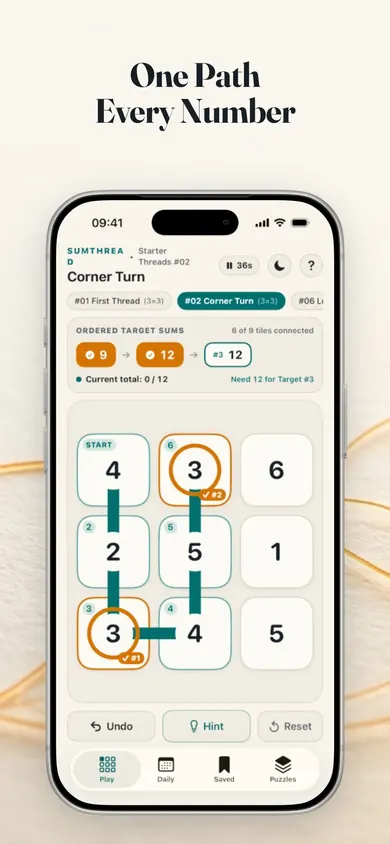
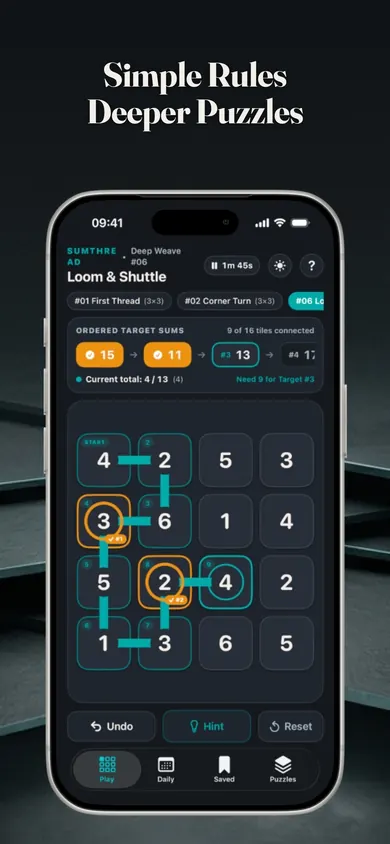
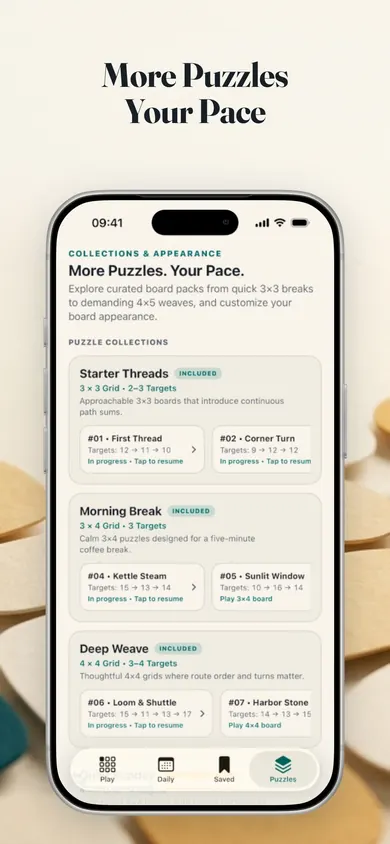
Sumthread has five curated collections, from 3×3 Starter Threads to 4×5 grids, plus one Daily Thread a day. Optional step-order badges and high-contrast tile borders help when you are learning to read a board. A limit to know: it is a number-path puzzle only, so if you want to practice sudoku or grid-deduction puzzles, pick an app built for those.
From guessing to naming
A typical first week: you drag a thread across a 3×3 board, overshoot the target, undo one step, overshoot again and assume the puzzle is broken. Then someone tells you the word "forced move". The next morning the bottom-left corner tile is suddenly obvious: it has one free neighbor, so the thread has to go there. Nothing about the board changed. You just had a name for what you were looking at.
That is the design decision behind this page and behind Sumthread's dashed reach cues: we show which neighbors are reachable so forced moves are visible early, while you are still learning to see them.
Questions about getting better at logic puzzles
How do I get better at logic puzzles as a beginner?
Learn the names of the common moves, then hunt for forced moves before anything else. Naming a move turns a lucky guess into a check you can repeat on the next board.
Is it cheating to guess in a logic puzzle?
It is not cheating, but it is slow. A good puzzle has one answer you can reach by reasoning. When you catch yourself guessing, stop and look for a forced move or a dead end first.
What is a forced move?
A move you must make because every other option breaks a rule. In a path puzzle, a tile with only one free neighbor left is the classic forced move.
What does parity mean in puzzles?
Parity is an odd-or-even count. Color a grid like a checkerboard: every step in a path changes color, so on a 3×3 board a path that starts on a corner must also end on a corner-colored tile.
How long does it take to get better at logic puzzles?
There is no fixed number. Most people notice a change once they stop guessing and start looking for forced moves on purpose, which a few small boards a day is enough to practice.
Which logic puzzle should a beginner start with?
Start with a small grid where every move can be checked: a 3×3 path board, an easy sudoku or a small Kakuro. Small boards make each technique visible.
Does Sumthread have hints?
Yes. Sumthread has a hint button and undo. Finishing a board with zero hints and zero undos earns the Clean Weave seal, so hints never block you, they just change the seal.
Start on your iPhone
Start on your iPhone with the 3×3 Starter Threads, name each move as you make it, and move up a collection when forced moves start jumping out at you.

Start Sumthread on the App Store
Updated November 2026
Related
- Sumthread: the calm number path puzzleTrace one path through every tile and hit the target sums in order. A quiet number path puzzle for iPhone: offline, no ads, no account.
- Games like LinkedIn Zip: your questions answeredFinished today's Zip and want more? What makes a game feel like Zip, which iPhone apps share its rule, and where Sumthread fits.
- How to practice LinkedIn Zip between daily puzzlesZip gives you one board a day. Practise the same one-path skill on a playable board here: clean first, then timed, then bigger.
- How to keep a daily puzzle streakHow to keep a daily puzzle streak going: 7 tips, a 14-day streak tracker you can tap, and what habit research says about missing a day.