How do you practice LinkedIn Zip?
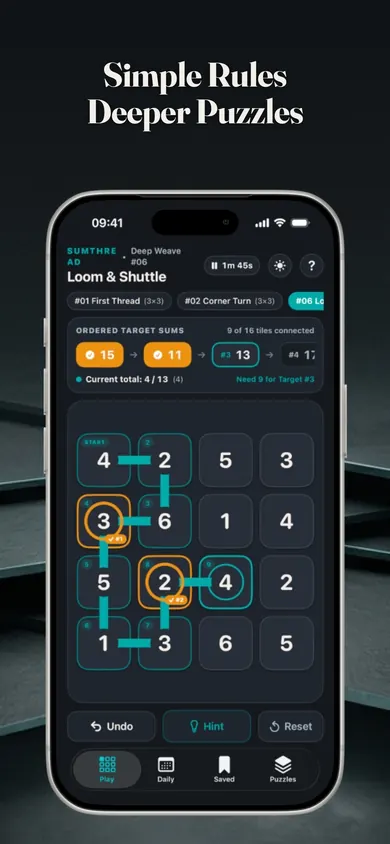
You practice LinkedIn Zip by drilling the skill underneath it, one path through every square with no diagonals, on extra boards: solve slowly and cleanly first, then against a clock, then on bigger grids. LinkedIn adds one new Zip a day (Social Media Today, March 2025), so the extra reps have to come from somewhere else. The board at the bottom of this page is one; Sumthread, the app we make, has five collections more.
How to practise one-path puzzles, in 3 steps
- Clean before quick. Solve with no undo at all. Sumthread rewards a board finished with zero hints and zero undos with a Clean Weave seal, which is a good target for drill one.
- Then put a clock on it. Replay boards you have solved and try to beat your time. The board timer sits at the top of the screen in the app, and our demo below times you too.
- Then size up. Move from 3x3 Starter Threads to 3x4 Morning Break, then 4x4 Deep Weave and finally the 4x5 grids. Zip's own difficulty rises through the week, Monday easiest and Sunday hardest (Business Standard, March 2025), so it pays to train above Monday level.
Clean, then quick, then bigger: that order stops speed from hiding sloppy habits.
Honest limits
- Sumthread is not Zip. There are no numbered dots; you add the tiles you pass, so a little arithmetic replaces reading the next dot.
- No leaderboards and no streak against colleagues. History stays on your device.
- We believe the path habits carry over to Zip, but nobody has measured it. Practice, not a guarantee.
- The collections are finite: five curated packs plus one Daily Thread a day.
One design decision we made: the final target must finish on the last free tile. That keeps every board honest about using every square, which is exactly the Zip skill that slips when you rush.
A mini story: Sunday's Zip
Monday's Zip takes you nine seconds and you feel brilliant. Sunday's takes two minutes, and the last square, a corner, is stranded on the far side of the board.
So on the train you play three Sumthread boards. Not to beat Zip, just to rehearse the move you missed: before turning away from an edge, check that nothing behind you is now cut off. By the next Sunday you still need more than nine seconds. But the corner is not the problem any more.
Play a practice board: 4 rows, 3 targets
Start on the top-left tile. Tap an adjacent tile to extend the path (no diagonals), or tap a tile already on the path to back up to it. Hit 13, then 21, then 17, and finish on the last free tile.
Your first tile is in. Where next?
Zip practice questions
Can you play old LinkedIn Zip puzzles?
LinkedIn releases one new Zip each day, so most players run out after a minute or two. Extra practice has to come from other one-path puzzles, like the board on this page or Sumthread's collections.
Is Sumthread the same as Zip?
No. Both ask for one continuous path through every square with no diagonals. Zip marks checkpoints with numbered dots; Sumthread hides them behind ordered target sums you reach by adding the tiles you pass.
Why is Zip harder on some days?
Business Standard reported at launch in March 2025 that Zip's difficulty rises through the week, with Monday easiest and Sunday hardest.
Does practising on other path puzzles make you faster at Zip?
We think the core habits carry over, such as leaving no square stranded and planning two steps ahead, but we have no study that proves it. Treat it as practice, not a promise.
Is Sumthread free?
Yes. The App Store page lists no in-app purchases, and the listing says no ads, no account and no third-party tracking.
Make it a habit with Sumthread
Do today's Zip. Then do one more path, clean, on the way home.

Related
- Games like LinkedIn Zip: your questions answeredFinished today's Zip and want more? What makes a game feel like Zip, which iPhone apps share its rule, and where Sumthread fits.
- Sumthread: the calm number path puzzleTrace one path through every tile and hit the target sums in order. A quiet number path puzzle for iPhone: offline, no ads, no account.
- 5-minute brain games for a work breakA beginner's guide to 5-minute brain games for a work break: what to look for, a try-it board, and a calm number path puzzle that saves mid-move.
- How to solve number path puzzles: 6 tricksStuck on one-line number path puzzles? Six checks (corners, parity, totals, overshoot) worked through on a real 3x3 Sumthread board.