How do you get faster at mental addition?
You get faster at mental addition by remembering a few key facts instead of working them out, then practicing small running sums for five minutes a day. Not a bag of tricks. Three moves cover most everyday sums: pairs that make 10, adding through 10, and tens first.
These are the same strategies American first graders meet in the Common Core standard 1.OA.C.6 (2010): counting on, making ten, and easier equivalent sums such as 6 + 6 + 1 for 6 + 7. Adults who missed them, or forgot them, can pick them up in a week.
A worked example from one board
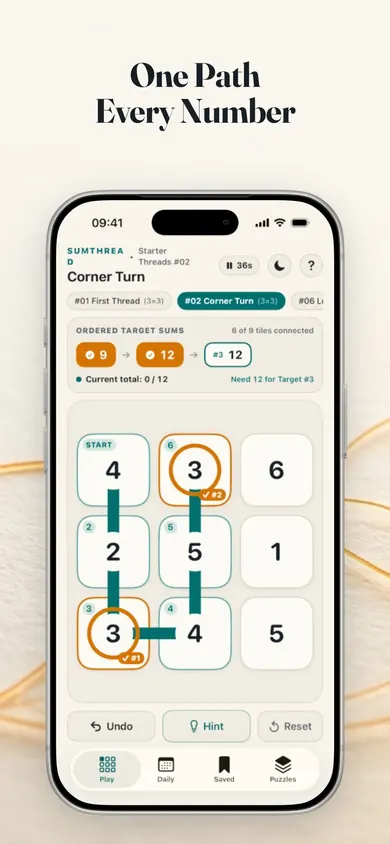
The first Starter Threads board asks for 12, then 11, then 10. You start on 3. Tap the 5 beside it: 3 + 5 is 8, so you need 4. The 4 is next door, the sum lands on 12, and that tile locks as a checkpoint. The count drops to zero and you start again toward 11. Every move is one small addition you can check.
Speed is memory, not talent.
Your first week of mental addition practice
Five minutes a day. Each day adds one move. The puzzle part is Sumthread, our number-path game: trace one path through every tile and hit the target sums in order. Every tap adds a number to your running total, so you are practicing the whole time.
Pairs that make 10
1 and 9, 2 and 8, up to 5 and 5. Say them twice, then play three Starter Threads boards and say every running sum out loud.
Add through 10
8 + 7 is 8 + 2, then 5 more. On each board, before you tap, say the number you still need for the target.
Doubles and near-doubles
6 + 6 is 12, so 6 + 7 is 13. Spot two tiles that are neighbors or doubles and add them as one chunk.
Tens first, left to right
36 + 27: 36 + 20 is 56, plus 7 is 63. Off the app, add up one shopping receipt this way before you look at the total.
Add 9 as 10 minus 1
+9 is +10, then back 1. +29 is +30, then back 1. Try three of these on numbers you see today: a price, a page, a bus number.
One clean board
Play the Daily Thread with no hints and no undos. Finish that way and the app gives you the Clean Weave seal.
Look back
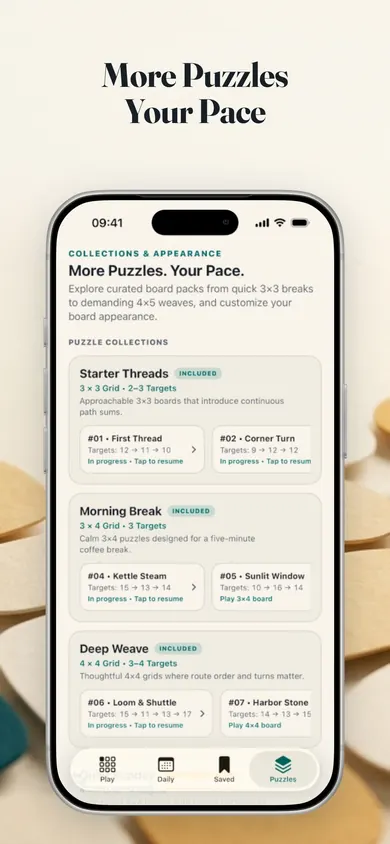
Open the Daily screen's completion history and average time. Then try a 3×4 Morning Break board and notice which facts you still count out.
Why running sums beat flashcards in week one
| Method | Good at | Weak at |
|---|---|---|
| Flashcards and timed drills | Locking in single facts | Easy to quit by day three |
| Running-sum puzzles (Sumthread) | Adding in context, with an exact target to check against | Small numbers only, no carrying |
| Everyday sums: receipts, scores | Real use, two-digit numbers | No feedback unless you check |
| A soroban or mental-math course | Deep, structured method | Weeks of study before it pays off |
We would mix the first two with the third. The design choice we made in Sumthread that fits this: the target sums sit at the top in order, and the app shows how many you still need, so every board checks your adding as you go.
Mental math questions adults ask
How can I add numbers in my head faster?
Learn the pairs that make 10, then add through 10 (8 + 7 is 8 + 2 + 5), and for bigger numbers add the tens first, left to right. Speed comes from doing a few small sums every day, not from one long session.
Why am I so slow at mental math as an adult?
Usually because a few basic facts are still worked out, not remembered, so every sum takes several hidden steps. That is fixable at any age with short, regular practice on small numbers.
How long does it take to get faster at mental addition?
There is no fixed timeline, and we will not promise one. A week is enough to learn the moves and notice which facts you still count out. Most of the speed comes after that, from keeping the habit.
Is counting on fingers bad?
No. It is a reliable method, just a slow one. The aim of the first week is to replace counting with a few known facts and the make-ten step, one fact at a time.
Does Sumthread help with mental math?
It gives steady practice at running sums with small numbers: every move adds a tile to your total, and you need an exact target. It is a puzzle, not a math course, and it does not teach carrying or large numbers.
Is Sumthread free?
Yes. The App Store page lists no in-app purchases, and the listing says no ads, no account and no third-party tracking. It works fully offline.
Honest limits
- Sumthread's tiles are small numbers. It builds fluent single-digit adding, not long multi-digit sums.
- Amber cues show which neighbor completes a target. Try to name the number before you look.
- It does not test subtraction or multiplication.
- iPhone only. If you want a full structured course, a mental-math book or class is the better pick.
Day 1 takes five minutes
We make Sumthread. It is free, offline, with no ads and no account. Get Sumthread free and start with three Starter Threads boards.

Updated November 2026
Related
- Sumthread: the calm number path puzzleTrace one path through every tile and hit the target sums in order. A quiet number path puzzle for iPhone: offline, no ads, no account.
- Christmas number puzzles for adults: 3 boards to playThree free Christmas number puzzles for adults, playable on this page: thread one path through every tile and hit the 12/24, 12/25 and 12/31 sums.
- How to solve number path puzzles: 6 tricksStuck on one-line number path puzzles? Six checks (corners, parity, totals, overshoot) worked through on a real 3x3 Sumthread board.
- 5-minute brain games for a work breakA beginner's guide to 5-minute brain games for a work break: what to look for, a try-it board, and a calm number path puzzle that saves mid-move.