What is the make a ten strategy?
The make a ten strategy is a way to add across 10: you split the second number so part of it tops the first number up to 10, then add what is left, so 8 + 5 becomes 8 + 2 + 3, which is 10 + 3, which is 13. It is in the US first-grade standard, Common Core standard 1.OA.C.6 (2010), whose own example reads 8 + 6 = 8 + 2 + 4 = 10 + 4 = 14. If the homework sheet looks like a string of equals signs, that string is the strategy written out.
The reason it is taught is not fashion. Adding to 10 is easy because children already know the pairs that make 10. Adding past 10 by counting on, one finger at a time, gets slow and error-prone. Making ten turns one hard step into two easy ones.
Two easy steps instead of one hard one: top up to 10, then add the rest.
Honest limits before you start
- We make Number Beasts, and it is a puzzle, not a curriculum. There are no lessons, worksheets or teacher dashboards in the listing. It gives your child the make-ten move to play with; the explaining is still yours.
- It assumes bonds to 10. Every beast pops at exactly 10. A child who cannot yet say what goes with 7 to make 10 will guess. Start with fingers or a ten frame for a few nights.
- 45 stages is a finite number. There is a new Daily Lab each day, but the handcrafted stages end.
- iPhone only. No Android or web version.
How Number Beasts turns make a ten into a move, in 3 steps
- Tap a beast. Each beast shows a number and pops when it reaches exactly 10. The launcher lines up the shot.
- Read the preview. With aim assist on, the whole path and the sum appear before you launch, for example BOND 4+6=10.
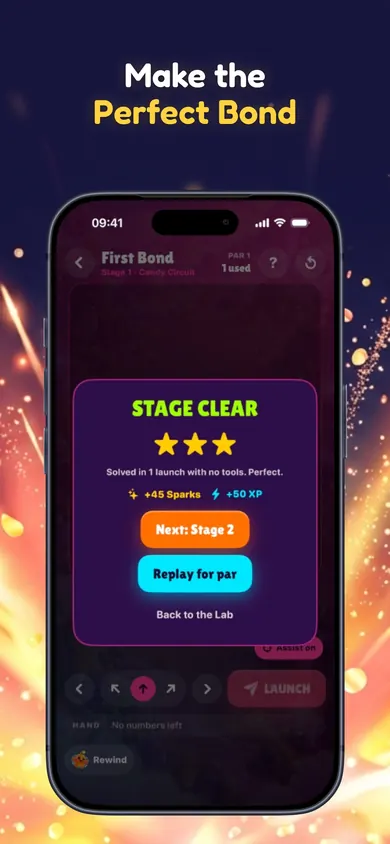
- Launch and watch. Exactly 10 is a BOND and the beast pops. Fall short and it FEEDS. Overshoot and it BRIDGES: the beast pops and the leftover keeps flying.
The BRIDGE rule is the make-ten strategy as a physical event. The listing's own example: launch a 7 into a 5 and a 2 carries on to the next beast. That is 5 + 7 = 5 + 5 + 2, the homework line, happening on screen.
Your first week: a make a ten plan for seven nights
Ten minutes a night, at the table or on the sofa. Skip a night whenever you like; the order matters more than the pace.
- Night 1
Say the pairs out loud
No phone yet. Hold up fingers and ask what goes with 6 to make 10, then 3, then 8. Then play the first Candy Circuit stage together with aim assist on.
- Night 2
Talk about need
Point at a beast showing 6 and ask what it needs. When a launch falls short, the beast grows and needs less. Say it: it had 6, got 2, now needs 2.
- Night 3
Find a bridge
Look for a launch bigger than a beast needs. Before pressing Launch, ask what will be left over. Then watch the leftover fly on.
- Night 4
Write it the school way
Take last night's bridge and write it on paper as the homework does: 7 + 5 = 7 + 3 + 2 = 10 + 2 = 12. The beast was the picture; now it is a sentence.
- Night 5
Aim assist off, once
Switch the preview off for one stage. Your child has to plan the sum before launching. If it gets frustrating, switch it back on; nothing is lost.
- Night 6
Play the Daily Lab
A fresh puzzle made on the device and checked as solvable. Let your child hold the phone and tell you the plan.
- Night 7
Swap roles
Give your child a sum from real homework, like 9 + 4, and ask them to explain it to you as if you were the beast.
Picture first, sentence second: the game is the picture, the homework is the sentence.
A mini story: the homework line that made no sense
It is Tuesday, 6:40 p.m. The worksheet says 8 + 6 = 8 + __ + __ = 10 + __ and your child is near tears because you said just count on, and the teacher said not to.
You put the pencil down and open Number Beasts. A beast shows 8. You ask what it needs. Two, your child says, because that one they know. You launch a 6 at it. The beast pops, and something keeps flying. How much? Four. You pick the pencil back up: 8 + 2 + 4. Then 10 + 4. Fourteen. The blanks fill themselves.
You did not teach a new method; you gave the old blanks a picture.
Who this plan is not for
- Children who are not yet sure of the pairs that make 10. Spend a week on fingers, beads or a ten frame first.
- Families who want a full math program with lessons and progress reports. A curriculum app or your school's platform fits better.
- Children who already add across 10 in their heads without fuss. They will enjoy the Chaos Laboratory beasts that need 15 or 20 more than this week.
One design decision we made: the hero tools (a rewind, a plus-or-minus-one nudge, a move reveal) are always there, but any tool caps a stage at two stars. Help is never taken away; it just shows.
Make a ten questions from parents
Why don't schools just teach counting on?
They do, as one strategy. The first-grade standard lists counting on and making ten side by side. Making ten matters because it scales: once a child can top up to 10, the same move works for 28 + 5 or 47 + 6.
What grade learns the make a ten strategy?
In the US it appears in the first-grade operations standard, 1.OA.C.6, which uses 8 + 6 = 8 + 2 + 4 = 10 + 4 = 14 as its example. Many children meet bonds to 10 in kindergarten first.
Is make a ten the same as bridging through ten?
Yes, the idea is the same. Bridging through ten is the name often used in England; make a ten or making ten is common in the US.
My child knows 8 + 2 = 10 but still counts on fingers for 8 + 5. Is that normal?
It is a common gap. Knowing a bond and using it to split another number are two different steps. The second step usually needs a picture or an object for a while, which is what the nights in this plan practise.
Is Number Beasts free?
Yes. The listing says no ads, no accounts, no tracking and no in-app purchases, and everything works offline.
What age is Number Beasts for?
It is rated 4+ on the App Store. Bonds to 10 suit roughly kindergarten to second grade; the third world, Chaos Laboratory, adds beasts that need 15 or 20 and plus, minus and times converters for older children.
Try it tonight
One beast, one bridge, one homework line that finally makes sense.

Number Beasts: Bond Lab on the App Store · Updated November 2026
Related
- Number Beasts: the make-ten number bond puzzleLaunch a number, make 10, carry the rest. A turn-based number bonds puzzle for iPhone with 45 stages. No ads, no purchases, offline.
- When your child says "I'm bad at math"What to say when your child says they're bad at math, why the label sticks, and a 20-second untimed puzzle they can win by planning, not speed.
- What to do when your child still counts on fingersFinger counting is a normal stage. Pick your child's situation for the next step to try, from counting on to make-ten games, with sources.
- Math games instead of worksheets: which swap fitsWhen worksheets end in tears: compare a card game, a shorter sheet and a make-ten puzzle app, then take a 3-question quiz to pick one.